
Revamping My JulNoWriMo Goal
I set the bar rather high for myself this year when it came to planning for JulNoWriMo. Last summer’s attempt spawned about a third of my chick lit romance, and that was without any prior thought or outlining. Not so this year. Not only did I already have about 15k words on the historical romance (HR) I wanted to tackle, but I sat down and wrote a whopping 15 page extended synopsis so I knew (in a general way) precisely what would happen in the story.
My goal was to complete the HR in around 80,000 words, give or take 5k or so. I felt very ready to begin. I had the kernels of the story ready to go, I had about three chapters already done – though they needed some heavy editing before moving on. I even had the confidence that I’d be able to finish early.
Joke’s on me.
I’ve been plugging along pretty steadily, but as often happens, life keeps encroaching on my writing time. I had started to panic, but decided instead to just modify my goals. After all, it’s not like the world will end if I don’t finish the whole MS by July 31st. The whole point of JulNoWriMo and other such writing challenges is to make you sit your butt in the chair and write.
Right now I’m sitting on about 34k words. Not too shabby, really. Not as impressive considering that I started with a little less than half of that. But I’ve written almost 20k in three weeks. Mostly during the week and not utilizing the weekends much at all (I do still want to have a life). I’m not going to magically pull another 46,000 words out of thin air by the end of the month unless something rather drastic happens. Which could, but I’m not counting on it.
So here’s my new plan. I’m going to do my best to get to 50k. If I surpass it, great. If not, at least I have about 2/3 of the MS done. Shabbily in places, in desperate need of revision. But on paper. Or silicon or whatever my hard drive is made of. I had originally planned to finish the HR by the end of August, so I think modifying what I do for JulNoWriMo will put me in a more than adequate position to finish by then.
I can hear some of you right now, see you shaking your fingers at me. “But you set a goal for July! You should be pulling all nighters to meet it!”
Well, I’m not in college anymore, and my energy tanks by about 9:30 at night. Nobody’s keeping score. I’m still keeping my inner editor locked in a box. And honestly, easing up on the pressure is probably better for me and the MS in the end anyway.
Adventures in Historic Sewing – Embarkation!
You may recall that at the end of my post about the War of 1812/Jane Austen Weekend at the Genesee Country Village Museum, I said that I was rather tempted to get into historical sewing. Or something to that effect.
Well…

Historic Patterns Ahoy!
I know what some of you are thinking. Aren’t you supposed to be writing? The answer is, yes, and I am writing. I’m about a third of the way through my historical romance (hush hush on the details of that for now!). Unfortunately, it’s slow going at present; I’m hoping to have some major breakthroughs over the next week in which I hammer out 5k+ words a day in order to reach my deadline. I’m not into the work count deficit too deeply – yet. And so far I’ve been able to keep my inner editor locked in a box and away from my first draft.
So, I admit it – the last thing I need is to take on another project of any kind. Between my JulNoWriMo goals, managing general stuff around the house, prepping for a move to a new grade level, and ten thousand other things I should be doing… Yeah, getting into historical sewing seems an odd choice.
I’m still doing it.
The final bit of motivation comes from the fact that I’m starting to volunteer at Fort Ontario, which, at various points, holds events for the French & Indian War, the American Revolution, the War of 1812, the Civil War, and the standard, day to day depiction of the Fort as it was in 1868 (specifically). It would be awesome to have outfits for each era to wear for special events (or to be the most awesome, interactive tour guide ever.)
Of course, the trick is that I have to teach myself how to sew first. Hence the handy little blue book, The Lady’s Guide to Plain Sewing I from Kannik’s Korner, which has lots of nicely illustrated explanations for how to do proper basic hand stitches and so on. I bought a fabric quarter at Joann Fabrics, which I plan to use with light colored thread to practice (so I can see what I’m doing).
Beyond that, once I have the basic stitching down, I plan to make a couple Regency/Federal era items: a shift, corded stays, and a gown. I figure Regency is a good time period to begin with, since it’s a lot of straight lines and, compared to other fashion eras, doesn’t call for tons of fancy embellishment. And, since it’s a fashion era that predates machine sewing, the fact that I neither own nor have ready access to a sewing machine (not that I remember my 7th grade home-ec lessons on how to use one) is sort of a bonus. Since you all know how I am about historical accuracy and all…
The shift (I’ll be using Kannik’s Korner Woman’s Shift 1790-1820) is going to be my first project. Best to start from the inside out, right? Plus, it’s basically a lot of rectangles and is really simple.
From there I’ll move on to a set of corded stays, using Past Patterns #001. I realize that these particular corded stays are dated a bit outside the Regency era, but I’ve found several sources (and historic fashion bloggers) that site these as period appropriate. I expect this to be the most complicated of the three projects I’m undertaking, just because of the amount of cording. And I’ll either have to find appropriately sized busk and back stays to purchase, or use the included directions to make them myself (or beg the hubs to make them for me, pretty please with sugar on top).
Last, I’ll make a gown using this basic Sense & Sensibility 1804-1812 pattern. I haven’t done any real planning on this at all, other than the idea of using detachable sleeves to make the gown more versatile. We’ll see what happens.
So that’s it in a nutshell! The historical sewing ship is ready to sail – anchors away!
Gettysburg
Gettysburg National Military Park has been enjoying a huge influx of visitors this week, as it’s the 150th anniversary of the battle. Called many things – the “high water mark of the Confederacy”, the turning point of the Civil War, the bloodiest battle ever fought on American soil – it’s worth taking the time to know the history of this important site and the events that made it famous.
It would be beyond amazing to visit Gettysburg this week, due to the numbers of reenactors who are there, portraying military units and civilians. But I saw a photograph yesterday of the crowds at Devil’s Den, participants in a walking battlefield tour, and frankly, it wouldn’t be worth it. I’m not sure you’d even be able to learn anything with the thousands of people milling about as they are. I like visiting battlefields in their off seasons, when it’s not so crowded. It helps me retain the feeling of time and place. As such, the hubs and the in-laws and I visited Gettysburg last summer, at the end of July. So I guess you could say I marked the 149th anniversary of the battle.
(Sit tight, folks, this is gonna be a long one.)
The Battle of Gettysburg
Nobody planned to fight at Gettysburg in July 1863. But General Lee lost one of his most brilliant generals, Thomas “Stonewall” Jackson, after the Battle of Chancellorsville in May, and he wanted to take the fight out of war-ravaged Virginia. If the Confederate army could threaten major Union cities like Baltimore, Harrisburg, and the capital of Washington, it could bring a swifter end to the war – and Southern victory.
Historians have speculated on this; had Lee’s second invasion of the North been successful, the war could have ended that summer. Things hadn’t been going well for the Union armies, at least in the Eastern Theater. By the end of June 1863, the Army of the Potomac was on their sixth commander in two years. Yes, Grant and Sherman were tearing it up in the West, scrabbling to gain control of the Mississippi River. In fact, by the time Lee marched the Army of Northern Virginia into Pennsylvania, Grant had already been engaged in a six-week siege of Vicksburg, Mississippi – a siege that was destined to end with the Confederates’ surrender on July 4th, giving the Union control of the Mississippi and effectively cutting the Confederacy in half for the remainder of the war.
But in the East, General Meade was the latest in a long line of generals, from McDowell to McClellan to Pope (to McClellan again) to Burnside to Hooker, who had to face off against Lee and a Confederate army so used to victory, their commander thought them almost unbeatable.
At the end of June, the Army of Northern Virginia marched through Maryland and into Pennsylvania, and the Army of the Potomac pursued them. Lee had no idea where the Union army was, however, since his cavalry, the “eyes and ears” of the army, was no where to be found. Lee’s army was, initially, split, with General Ewell’s forces coming so close to the city of Harrisburg that he “could hear the church bells” ringing in the steeples. But he would have to turn his divisions around and march back toward the little town of Gettysburg, because that’s where the armies converged.
The first day of fighting, July 1st, was not of the large-scale caliber that would ensue in the next two days. North of the town, the Confederates used an unfinished railroad cut to advance upon the town – legend has it they’d heard there were shoes in Gettysburg, hence the detour – and two brigades of Hill’s Third Corps ran smack into Buford’s cavalry on McPherson’s Ridge, starting the battle.

The railroad cut is finished now, of course.
Reinforcements from both armies began to stream into the area, and the battle intensified. General Reynolds was killed, and the Union troops were pushed through the town itself before taking up positions on the high ground south of town on Cemetery Ridge. Lee gave Ewell discretionary orders to attack “if practicable”, but Ewell, who didn’t have the same sort of fire in his belly as Jackson had, did not attempt to take the high ground. It’s arguable what would’ve happened if he had done so. The Union army had yet to get all of their forces into place, and had Ewell pressed his advantage, it’s possible the battle would have ended that night.
But this was not to be, and by morning on July 2nd, Meade’s forces had their defensive positions in a huge fishhook that extended from Little Round Top, along Cemetery Ridge, and curved around to Culp’s Hill. Over the course of the next day, the fighting would be fierce and deadly, with no significant ground gained by the Confederates by night fall.
Lee ordered attacks on both flanks of the Union fishhook. On Culp’s Hill, Ewell attempted to dislodge the Union troops from their positions, but with little effect. The fighting was brutal, hand to hand at times, and wounded from both sides crawled to Spangler’s Spring to get water for themselves and others.

The spring is now filled. The plaque on the left says “One country and one flag. The strife of brothers is over.”
Meanwhile, down on the Union’s left flank, things weren’t going quite so well at first, even though they occupied the high ground. Longstreet’s Corps attacked, with General Hood leading an assault over the rough ground of Devil’s Den and what became known as the Slaughter Pen at the foot of Little Round Top. Fierce fighting continued as McLaws engaged Union troops in the Wheatfield and Peach Orchard throughout the day, when Sickles broke position on the high ground and brought his brigades too far forward. Despite heavy losses, the Confederates pressed their advantage, setting the stage for an assault on Little Round Top.

Devil’s Den

The Slaughter Pen
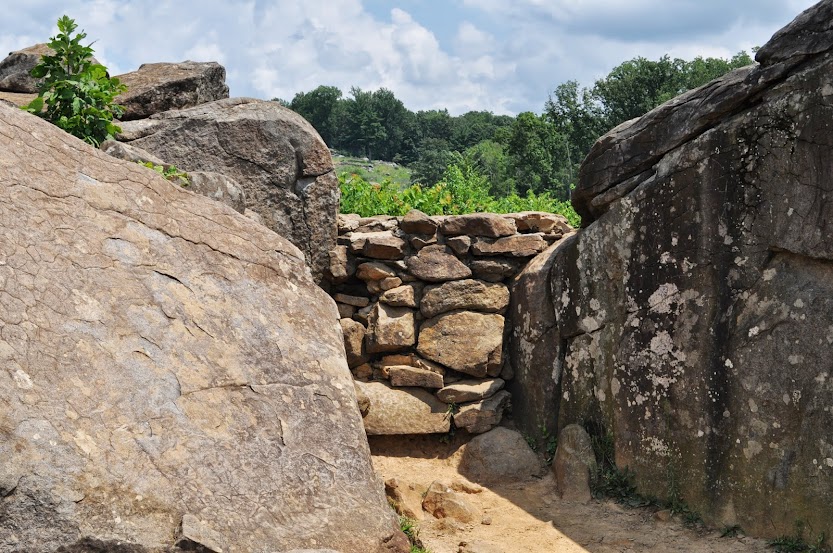
A Confederate sharpshooter’s nest, site of a famous, though staged, photograph by Alexander Gardner.

The original Gardner photograph, “Home of a Rebel Sharpshooter” (Image from Wikipedia Commons)
Here’s where the Union fishhook came into play. Meade had all interior lines of movement, and was able to move 20,000 men from other positions to reinforce the flanks at Culp’s Hil and Little Round Top. That doesn’t mean the fighting wasn’t desperate, and we’re all familiar with the famous bayonet charge performed by the 20th Maine, lead by Colonel Chamberlain. (It’s honestly one of my favorite scenes in Ron Maxwell’s “Gettysburg”.)
The charge of the 20th Maine was only a small part of the battle, and fighting would continue to rage on Culp’s Hill well into the evening. But it’s a great example of tenacity and the sort of courage displayed by many, many officers and enlisted men on both sides of the battle.
That night the Confederate cavalry under J.E.B. Stuart finally showed up, and Lee prepared for one last thrust at the Union army. A thrust he believed would crush the Union center, collapse their lines, and force Meade to retreat. Here’s where a lot of speculation comes in. Had Stuart’s cavalry been on site the entire time, had they reported the movements of Meade’s army prior to the battle, one could argue that the positioning, the planning, and execution of Lee’s maneuvers could have been quite different. Contemporary sources also point out that Lee wasn’t exactly well during the battle; he suffered from a heart ailment that would trouble him until his death in 1870, and it’s been said that the Confederate commander was ill and weak during the first days of the battle and this may have clouded his judgment.
Or maybe Lee thought, as many thought, that his army just could not be defeated. So he ordered Longstreet to engage the divisions under Pickett, the only truly fresh troops they had, Trumble and Pettigrew. The plan was to commence a frontal assault on the Union positions in the center of Cemetery Ridge, where the Union line was believed to be weakest. Lee ordered an artillery bombardment that would silence the Union artillery and further weaken the center. However, the bombardment did little except to deplete the Confederates ammunition, and when the 12,500 men began their march over a 3/4 mile stretch of open ground, they were exposed to Union artillery and, when in range, rifle fire that decimated their ranks.
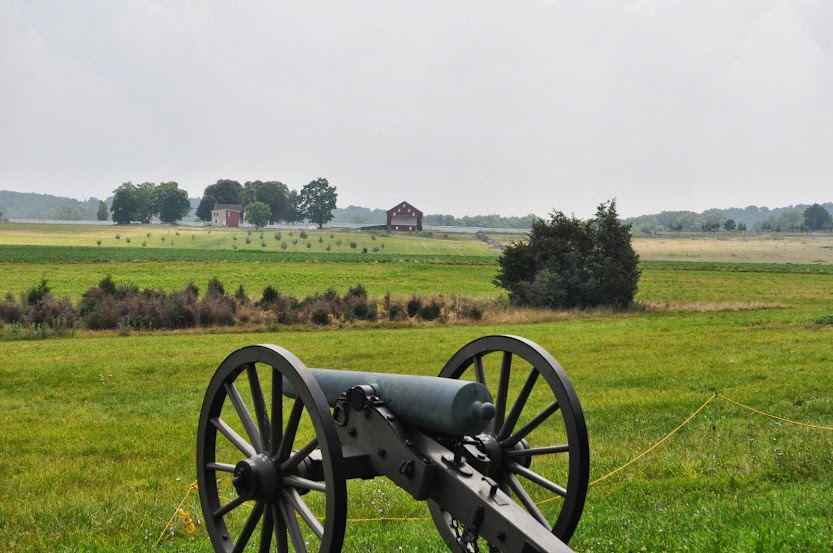
Confederate artillery position on Seminary Ridge

Looking out over the fields toward Cemetery Ridge. The large copse of trees a third from the right of the photograph was the point at which the Confederate charge should have converged.

Upon reaching the Emmitsburg Road, Confederate troops had to scale a five-foot high post and beam fence, further exposing them to the rifle and canister fire they were now within range of. Many men didn’t get farther than this fence.

Only Armistead’s Brigade, part of Pickett’s Division, reached the stone wall of the Angle, at the copse of trees, breaching the Union line. Armistead was killed, most men were killed or captured, and the rest of the forces retreated to Seminary Ridge
The men who survived “Pickett’s Charge” limped back to the Confederate positions on Seminary Ridge. The next day, July 4th, Lee began moving his shattered army back toward Virginia, and Vicksburg fell in the West. Meade did not pursue Lee until July 7th, and the two armies engaged in skirmishes and rear guard action for several days following the battle at Gettysburg. But by July 24th, the Army of Northern Virginia was beyond pursuit. Despite criticism from Lincoln and others in Washington, Meade remained in formal command of the Army of the Potomac until the end of the war, though Grant located his headquarters with the Army of the Potomac upon his appointment as Lieutenant General of all Union Armies in 1864.
Back at Gettysburg, civilians were left to deal with the scores of wounded and dead men around their small town. Soldiers were buried, most unidentified, and in November of 1863, the burial ground just south of Gettysburg was dedicated as a national cemetery. On November 19, Abraham Lincoln delivered a short address to recall the sacrifices of the men buried at Gettysburg, and all who had died, redefining the war and stating that “these dead shall not have died in vain—that this nation, under God, shall have a new birth of freedom—and that government of the people, by the people, for the people, shall not perish from the earth.”

The only known photograph of Lincoln giving the Gettysburg Address, November 19, 1863. Lincoln is the bareheaded man to the left-center of the photograph.
You can see more photographs from my trip to Gettysburg here.
More information about the Battle of Gettysburg can be found at:
- The History Channel: Battle of Gettysburg (a lot of great articles and videos, though I do not recommend the Ridley Scott documentary)
- Civil War Trust: Gettysburg (photos, videos, interactive and historical maps, articles)
- The Battle of Gettysburg: The American Civil War (Official Army site, info on people, weaponry, statistics, etc.)
- History Animated: Battle of Gettysburg (nice animation showing the battle)
Geeking Out in 1812
In some circles (such as this one), there’s a lot of periodic hype about the Civil War’s sesquicentennial, which we’re about halfway through at the moment. But this weekend, I had a chance to immerse myself in the War of 1812, America’s “forgotten” war, which celebrates its bicentennial starting this year.
I admit that I don’t know a whole lot about the War of 1812. *gasp* I have a working knowledge: It was between the British and Americans, the majority of the action was naval in nature and really focused on the Great Lakes area due to the proximity to Canada, which at the time was a British possession. It lasted from 1812 to 1815, but on the world stage it was a bit of a blip, since most of Europe was busy, you know, trying not to be taken over by Napoleon Bonaparte. Here in America it was a pretty big deal, as American sailors had been getting press-ganged into service aboard British naval vessels for years, among other issues. And then there was the whole burning down of Washington and the White House while Dolley Madison fled with a portrait of George Washington and some other important people and papers.
Around my neck of the woods, since I have a Great Lake in my own backyard, the War of 1812 was a rather big deal. A battle in 1814 marked the third time Fort Ontario was attacked and destroyed (once by the French, once by the British, once by the Americans). I’m looking forward to learning a lot more about this “forgotten” war in the next couple years. But in the meantime – GEEKERY!!
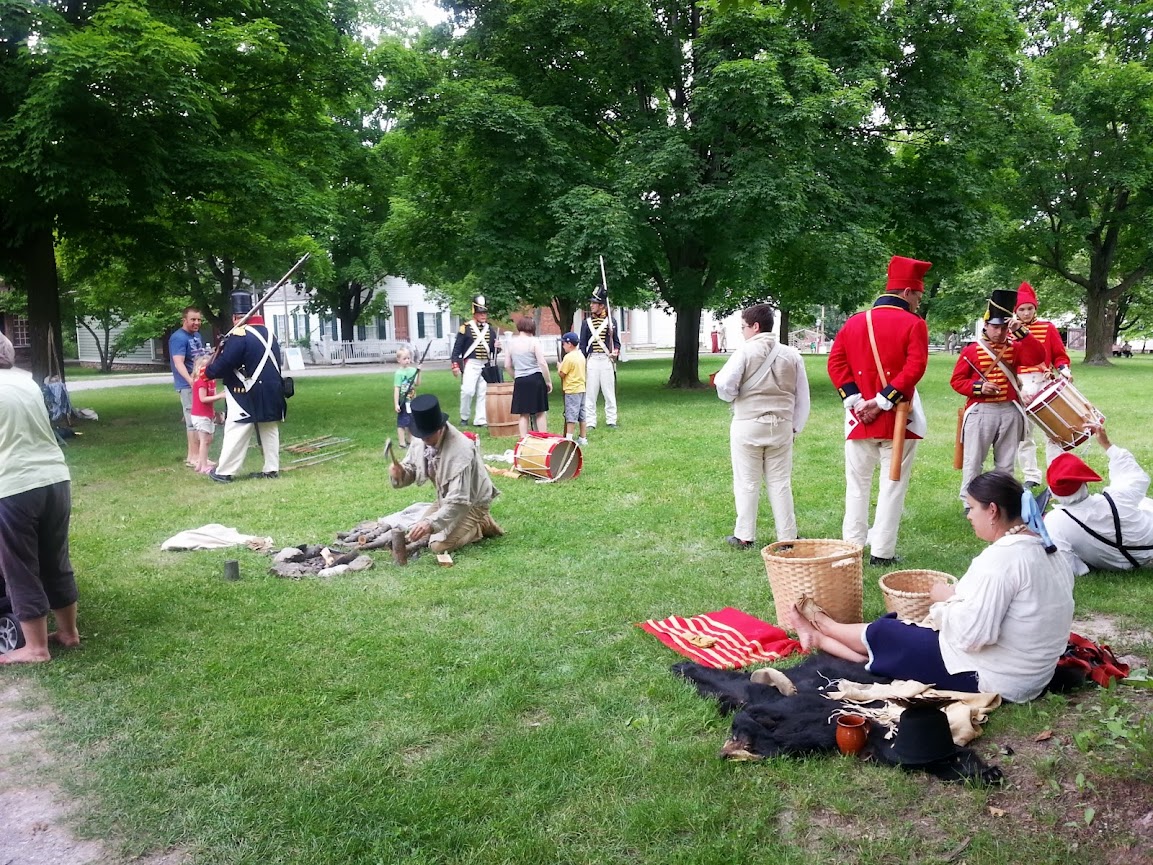
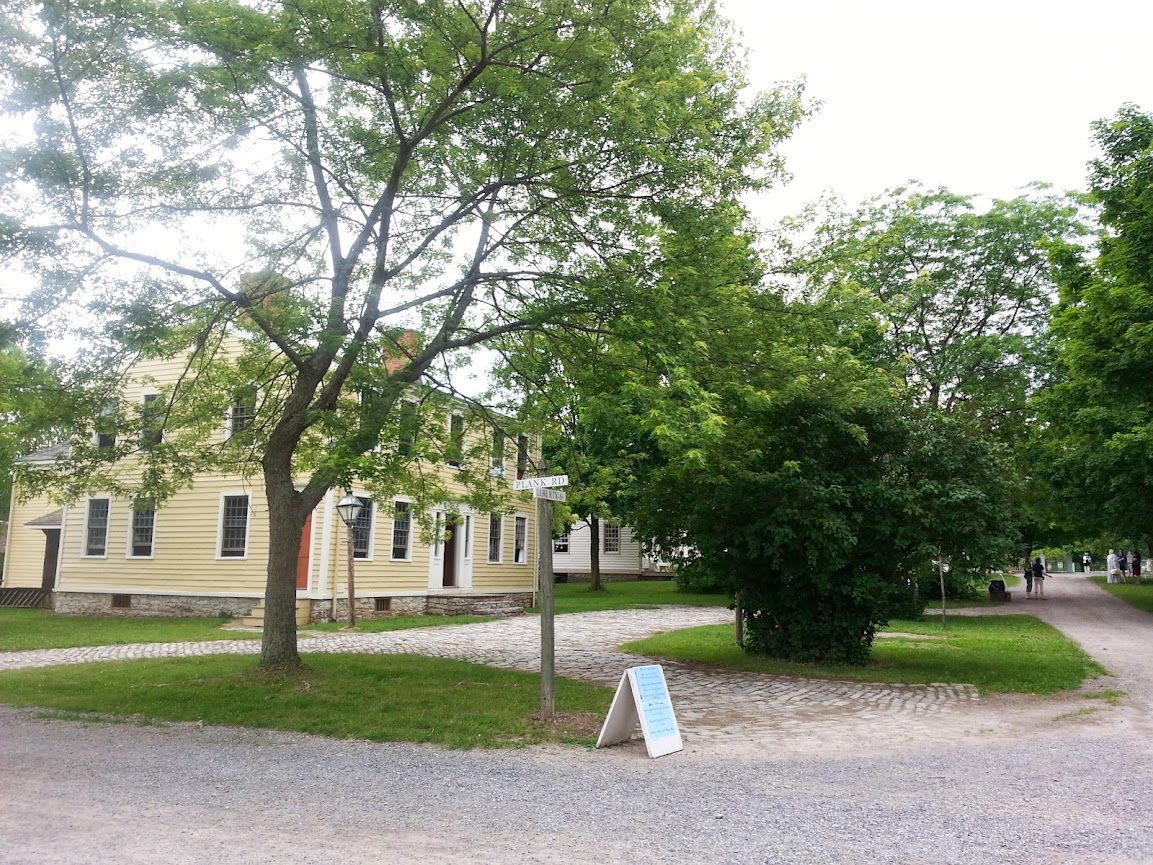
The Genesee Country Village Museum holds an annual War of 1812 reenactment, alongside a Jane Austen Weekend, in which the beautiful historic village transforms to display aspects of civilian life during the War of 1812 and the Regency Era (which we Americans would call the Federal Era, incidentally). The village itself is amazing, if you ever have a chance to visit. All the buildings are either reconstructions based on historical evidence, repurposed buildings that were originally something else, or actual historical structures that were moved to the village from all over New York State. It’s pretty amazing, and I’m planning/hoping to go back in a few weeks for their annual Civil War weekend, which boasts one of the largest reenactments in the Northeast.
Anyway, the reenactors, who had come from all over the country, depicted life in 1812 through military encampments, demonstrations, and just generally “populating” the village to give you a feel for the time period.
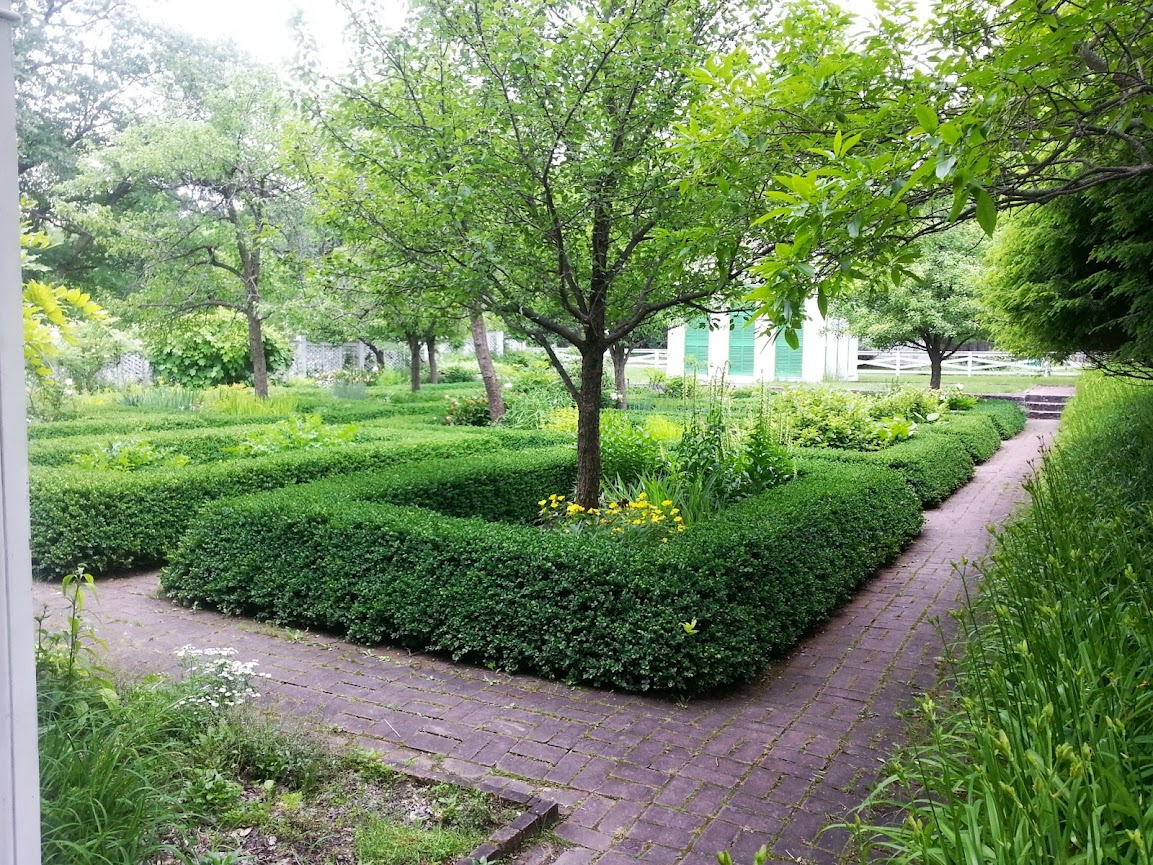
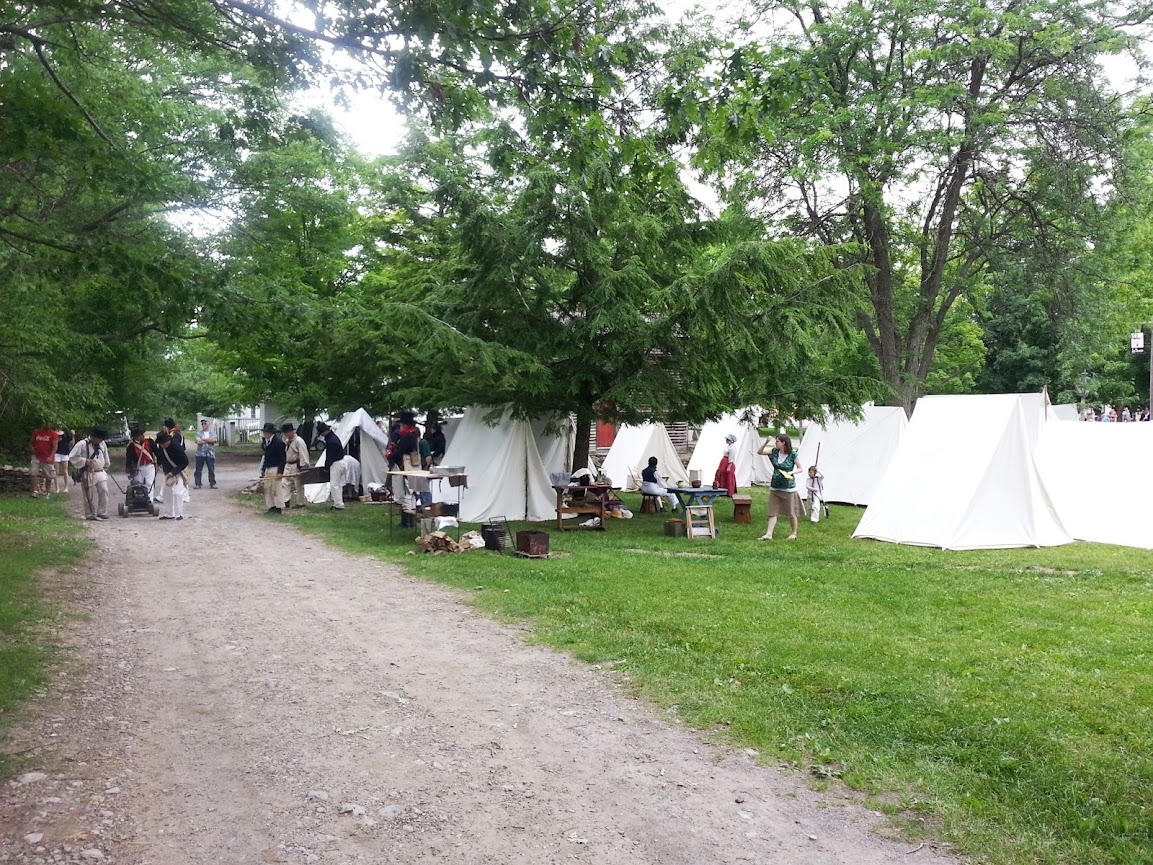
They even held small arms demonstrations with flintlocks, and, of course, artillery demonstrations.
My visit, however, had a totally ulterior motive. You see, I’ve been friends with Katie Jacobs for about twelve years. We “met” when I was in college and she was in high school, through an online writing group that may or may not have had to do with a particular anime show both of us enjoyed. *ahem* Anyway, since she lives in Michigan and I live in New York, we had never actually been in the same room together.
Until this weekend.
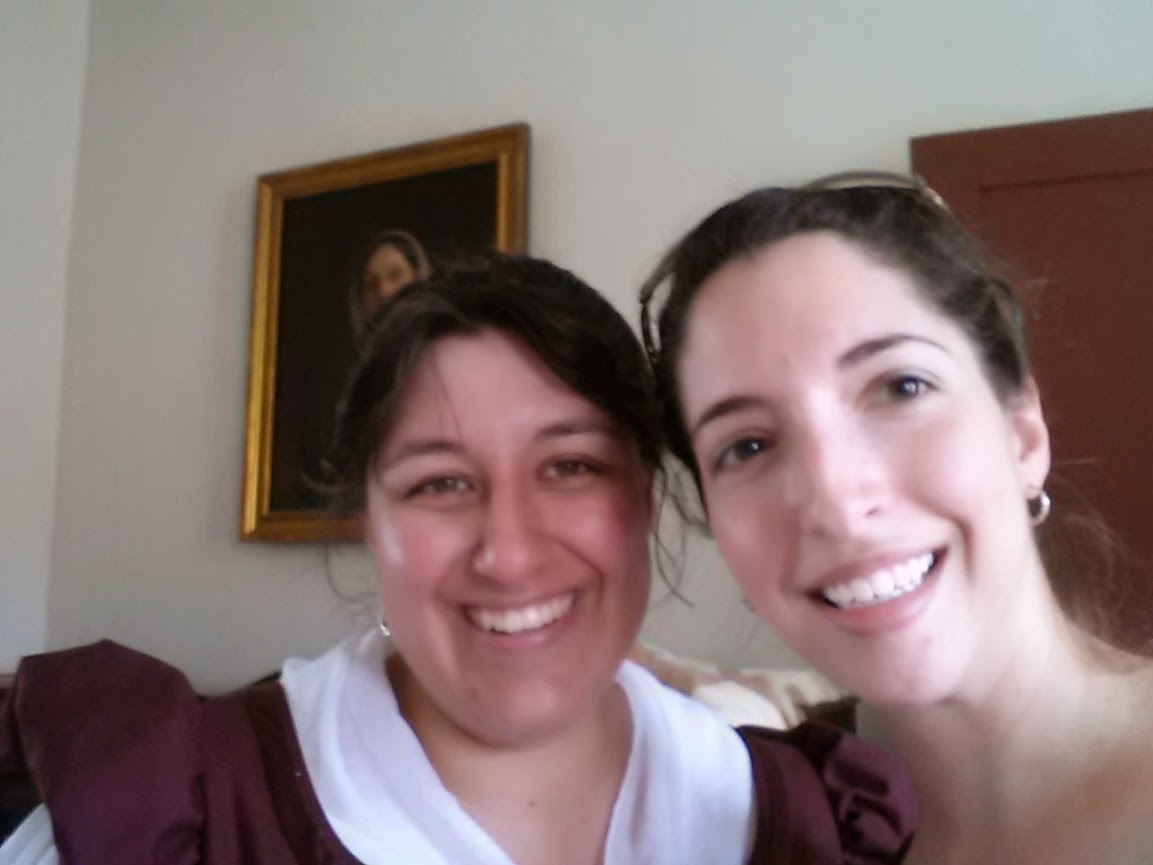
12 years of friendship. First time in a room together. Ever.
(Sorry for the super blurry picture. Sometimes self portrait shots are hard!)
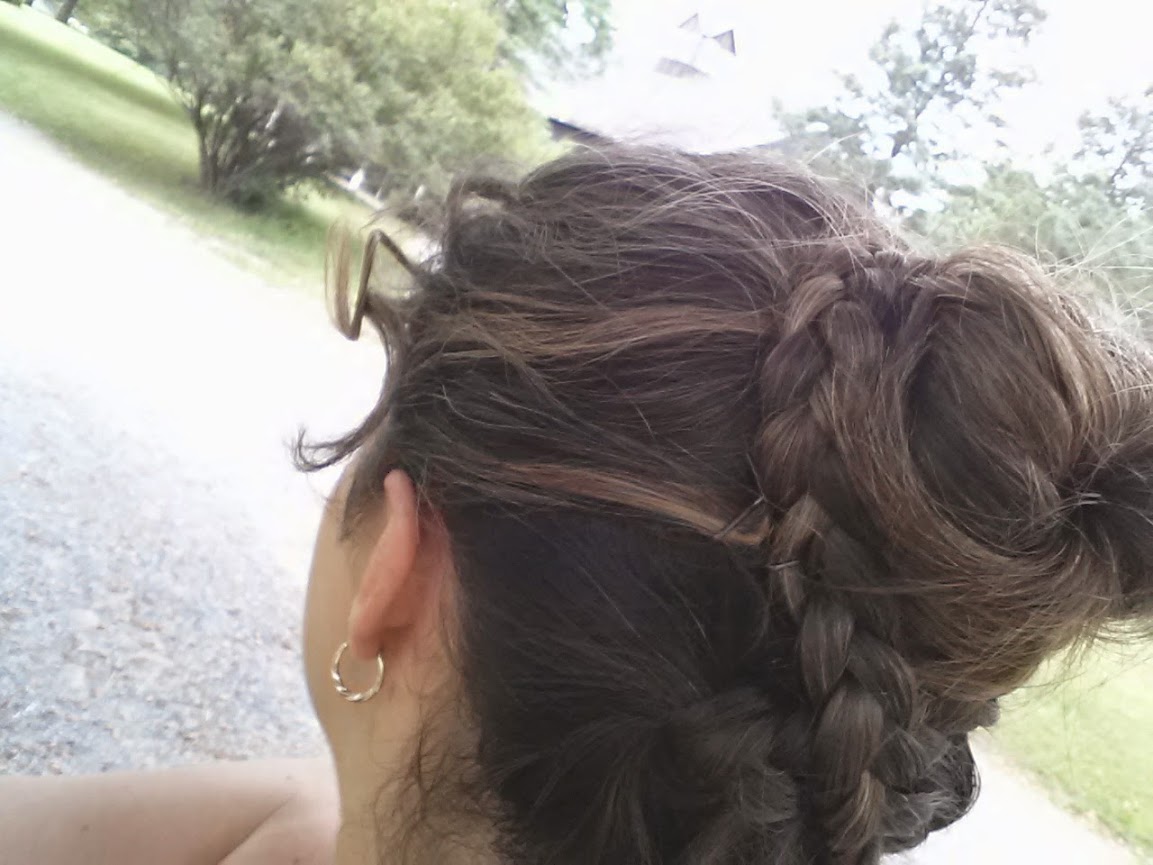
As you can see, Katie was at the Jane Austen Weekend being her amazing reenacting self. She and the group of ladies she was with were doing Regency hair demonstrations. Did I already say amazing? And I was so pleased and lucky to have Katie style my hair!
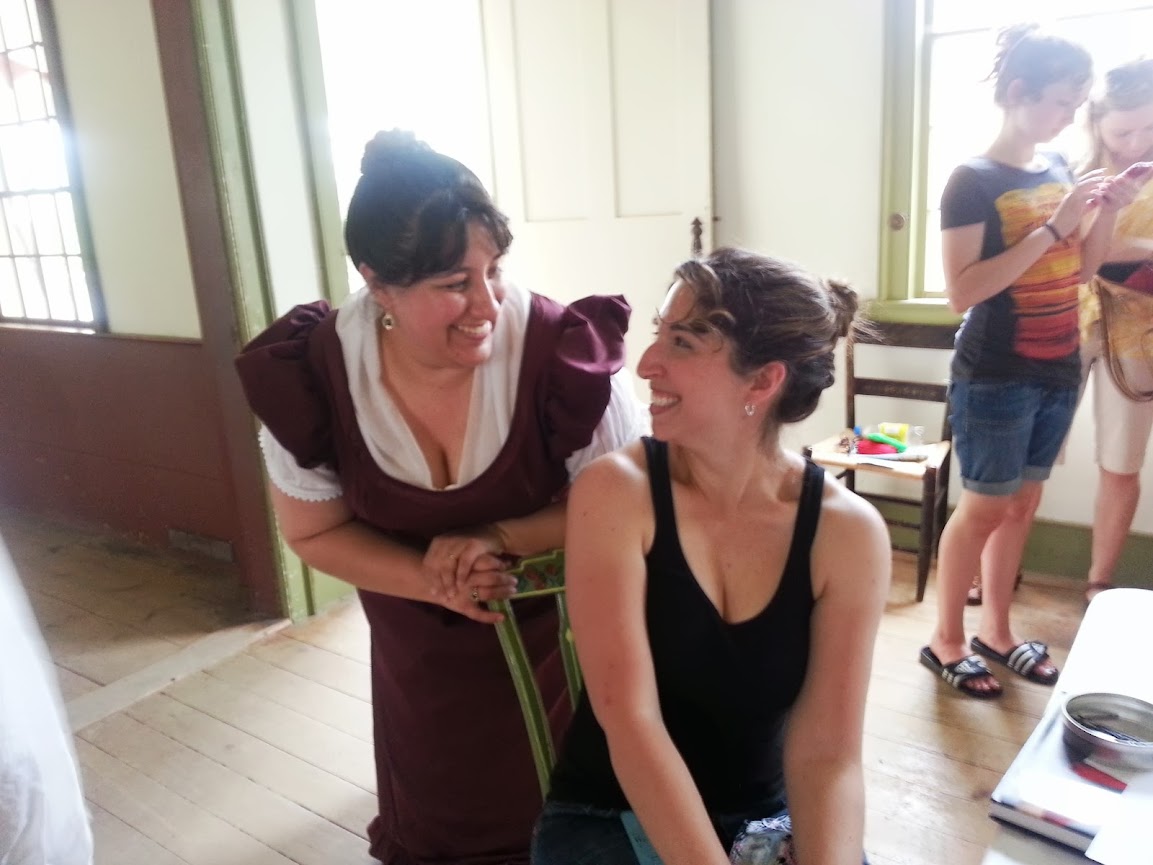
Basically all she did was pull the top half of my hair into a bun, then made two braids in the bottom half, which she then wrapped around the bun. She finished it off by adding some papillote curls to the front.

Now, the idea of getting into some low-level reenacting has been percolating for a while. But now I’m stoked at the idea. Except for the fact that sewing is, like, the one thing I don’t know how to do at all.
 J. Lynn Rowan