My choice will probably come as no surprise for anyone who has followed my blog for any great length of time.
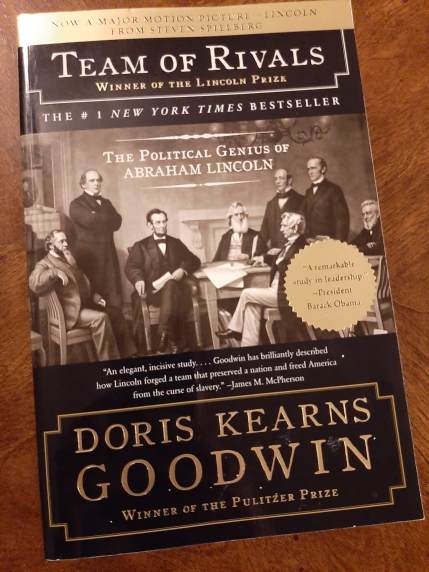
Team of Rivals: The Political Genius of Abraham Lincoln by Doris Kearns Goodwin
I’d heard about this book long before I ever read it, but didn’t have a copy of my own. I just added to my To-Read list and plugged along with other things related to history, etc. After the movie “Lincoln” came out in 2012 and I learned that the movie was based on the last several chapters of this book, I decided it was time to sit down and read it.
This book is a must-read for every Lincoln enthusiast, for every student of the American Civil War and American history.
And it is a must-read for every American. Especially right now.
Goodwin’s tome (yes, the thing is like two and a half, maybe three inches thick) is a hefty, time-consuming read. But it’s worth it. It’s imperative. Goodwin, as with all of her work that I’ve had the privilege to read, provides amazing historical detail, context, and copious references, while managing to make this academic magnum opus read almost as a narrative at times.
This is not just about Abraham Lincoln, or about his presidency and the things he did during the Civil War and his tenure in the White House. Goodwin takes us back to the very beginning, to Lincoln’s childhood and formative years. She paints a vivid picture of his development as a lawyer, statesman, and eventually leader of a country bitterly divided over the stain of slavery.
This is also a book about the men who will become integral members of his cabinet – William H. Seward, Salmon P. Chase, and Edward Bates – after losing the first Republican primary to Lincoln in 1860. We learn about these three men alongside Lincoln, how they came to the political fore, and most importantly, why Lincoln brought them into his inner circle when he gained the presidency. Goodwin weaves the ins and outs of the political convolutions Lincoln brilliantly (IMHO) executed in order to steer the country toward not just the salvation of the Union, but the passage of the 13th Amendment to the Constitution.
But she doesn’t stop there. As is true today, the wives of these four powerful men had their own intrigues and social workings that mirrored the drama playing out on the political stage, both in public and behind closed doors.
We also get to learn about the maneuvers Lincoln used with members of Congress, the evolution of his stance on equality for Black Americans, and the inner turmoil and private sufferings of a man who presided over the deadliest conflict in this country’s history. At the last, Goodwin shows us the immediate aftermath of Lincoln’s assassination just days after Lee’s surrender at Appomattox in such a way that the question remains – what would have happened if Lincoln had been able to serve out his second term in office?
America is on the cusp of an election that, in many ways, is not too different from the election of 1860. That election sparked a civil war that claimed the lives of an estimated 750,000 American men (per recent reevaluations of data) and fundamentally changed the definition of American citizenship and democracy. Team of Rivals may be daunting, but it should be read by every American who plans to cast a vote a month from now, as it illustrates with amazing detail how even bitter rivals can work together for the good of this country.
It’s been a while since I’ve posted a mini-history lesson, and today, the 150th anniversary of Lee’s surrender at Appomattox, seems a worthwhile reason to provide one.
The Beginning of The End
For a good year before Robert E. Lee decided it was time to surrender, the Union and Confederate armies were essentially locked in nonstop combat. Consider the opposition: Ulysses S. Grant’s campaign in Virginia through the spring of 1864; Phil Sheridan’s cavalry actions that would later be known as “The Burning of the Shenandoah”; Sherman’s drive to capture Atlanta and the subsequent “March to the Sea” that marked the summer and fall of that same year.
The odds were seemingly stacked against an army that suffered from a lack of food and ammunition. There were no more reinforcements. Many civilians had had enough. The only thing the Confederate army really had left was guts and determination.
But by April 1865, Lee knew he didn’t have many options left. Johnston was still fighting in North Carolina, and in the far reaches of the Confederacy, armies were still holding out. But in Northern Virginia, Grant was closing in. Petersburg had fallen. The Confederate government had fled Richmond, destroying records and supplies as they went.
The Confederate army continued to make valiant stands through those early days of April, including a battle at Appomattox Courthouse itself. If they could get to the Appalachians, many believed they could continue fighting for years through what we would today term guerrilla warfare.
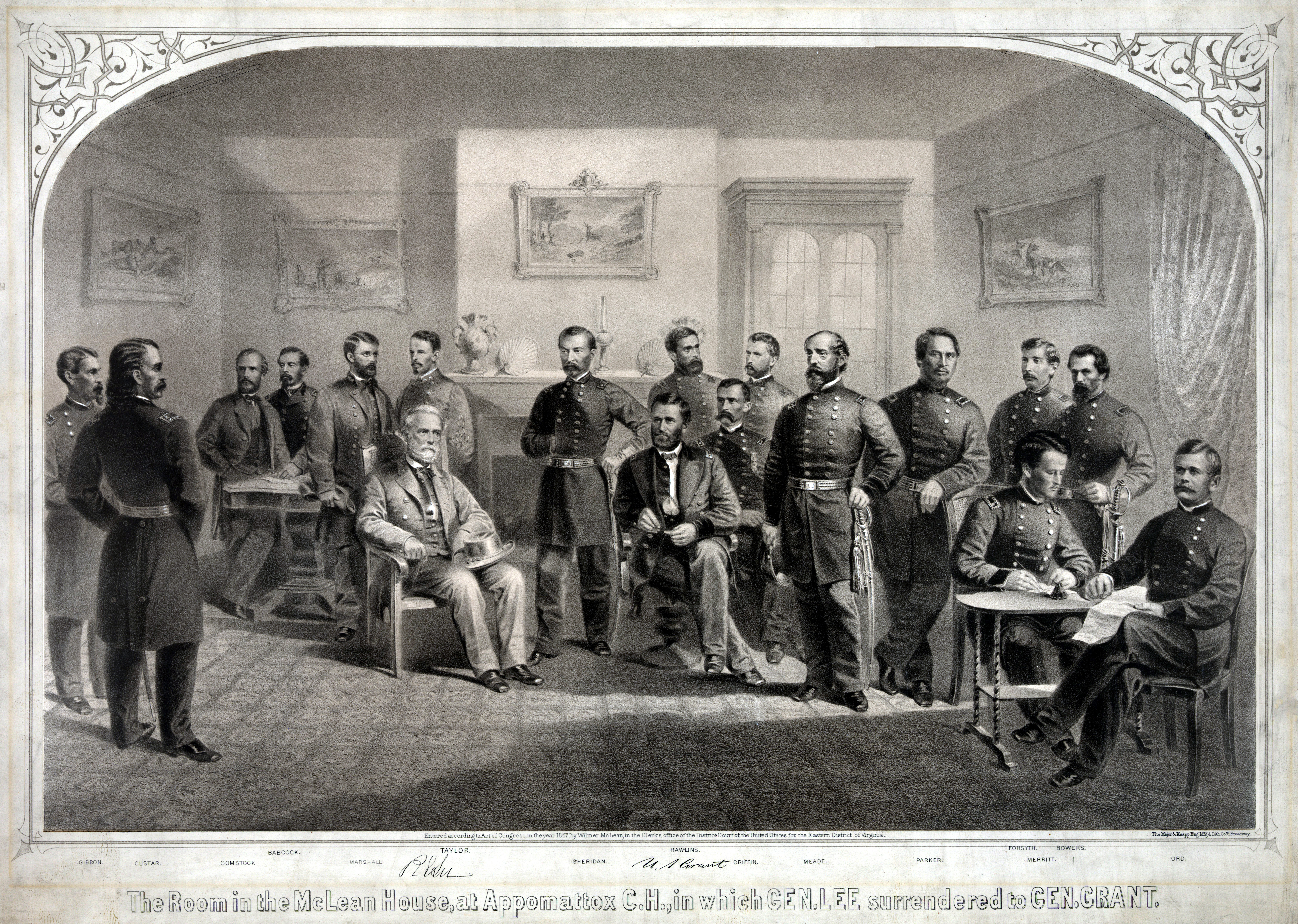
There’s a lot of legend surrounding the meeting of Lee and Grant at the MacLean house in Appomattox Courthouse. Yes, Lee did wear his best uniform. Grant did ride up and sit down with the famed Southern general with mud splattered boots. Whether or not Lee planned on surrendering that day is up for debate, but once he saw the terms Grant offered, he agreed to them.
Grant did offer very generous terms, given the bitterness of the past four bloody years. While military equipment had to be given up, officers and enlisted men alike were paroled. Officers could keep their sidearms, and any man who owned the horse he rode could keep it as well.
Both armies were tired. It was time to go home and resume the business of being Americans.
Contemporary accounts state that the meeting between these two generals was respectful, and the surrender is sometimes referred to as “The Gentlemen’s Agreement.” Certainly Grant, and definitely President Lincoln, wanted to avoid the terrible Reconstruction years that would follow Lincoln’s assassination.
But Not Quite The End
Lee’s surrender at Appomattox is usually considered the end of the War Between the States, though it really only dealt with one army in one corner of the South. Perhaps the proximity to Washington is what made the Army of Northern Virginia’s surrender so important, why history marks April 9, 1865, as the official end.
But Lee wasn’t the only one still fighting.
Remember that in 1865, there was no television or internet. There was the telegraph, which was extensively used by the Union, especially in those final months between Lincoln and Grant. But generally word traveled slowly on a good day, and in the war-torn south it traveled at a snail’s pace, or slower.
Other standing armies in the Confederacy eventually got word that Lee had surrendered. Johnston surrendered to Sherman on April 26th, near Durham, North Carolina. May 4th marked the surrender of General Richard Taylor’s army in Alabama, and Confederate Cherokee forces in what is now Oklahoma surrendered on June 23rd. The last Confederate victory of the war actually occurred on May 13th, at Palmito Ranch, Texas, before word of the end of the war reached the army there. And the last Confederate naval vessel to surrender was the CSS Shenandoah, which continued to harass Yankee whaling ships in the Pacific well into the summer. It wasn’t until August 2nd that the CSS Shenandoah’s captain accepted a report about the Confederate surrender (up to that point, the news had been dismissed as rumors), and it wasn’t until November 6th that the ship surrendered to British authorities in Liverpool.
The exact casualty rate can only be estimated, especially since the standard number of those killed between April 1861 and April 1865 (long set at about 620,000) doesn’t usually count civilians, enslaved blacks or those who freed themselves by escaping to contraband camps, or those who died after the war from disease or wounds. Even the official numbers of Confederate dead can only be estimated because many official Confederate records were destroyed when Davis and his government fled Richmond ahead of Grant’s army. Current estimates now place the death toll around 750,000, though there’s argument that it could be even higher.
And the toll of the war would continue to be seen in the millions of men left invalided by disease and crippled by horrific wounds, the result of Napoleonic tactics fought with modern weaponry.
Still Not The End
Lincoln wanted the Southern states to return to the Union as soon as possible, and for the entire country to get moving forward as one piece again. But after Lincoln’s assassination, all hope for a peaceful restoration of the Union went out the window. Radical Republicans had control of the United States government, and many wanted to punish the South for the past four years.
Enter the Reconstruction Era: nearly a decade of what many termed (and still term) a military occupation of the South by the Union army. Former Confederates were bitter. Their homes were ravaged by war and privation.
Black men were enfranchised by Federal law, but those in the South would effectively be disenfranchised by Jim Crow laws. Slavery was made illegal in the United States, but well into the 20th century, blacks in the south still existed in a state of slavery as they became sharecroppers, often to the families who once owned them and their ancestors.
Reconstruction was a violent era as well, spawning the birth of the Ku Klux Klan and many other paramilitary groups who sought to reestablish what they believed was the South as it once was. Supreme Court decisions like Plessy v. Ferguson paved the way for segregation laws, which wouldn’t be overturned until the Civil Rights Act of 1964 – 99 years after Lee surrendered to Grant.
Bitterness and hatred continue to plague us, even into the 21st century. Our country has come a long way in the past 150 years, but we’re nowhere near the ideal of equality and freedom we often believe the Founding Fathers envisioned for the United States. We’re still divided along lines of race, as well as gender, religion, and sexual orientation. But many of us are trying to figure out how to erase those lines, and understanding the outcome of the Civil War is an imperative piece of understanding who we are as a nation.
On that April day in 1865, Lee probably wasn’t thinking about the decades of turmoil yet to come. He was probably just thinking about his soldiers – starving, worn out, determined to go on if he just said so, even though they were running on empty.
It’s left for us to understand the aftermath, to learn from it, to make our country a better place for the sacrifices that were made – on both sides.
For more information about Appomattox, check out the Civil War Trust’s interactive learning site.
Gettysburg National Military Park has been enjoying a huge influx of visitors this week, as it’s the 150th anniversary of the battle. Called many things – the “high water mark of the Confederacy”, the turning point of the Civil War, the bloodiest battle ever fought on American soil – it’s worth taking the time to know the history of this important site and the events that made it famous.
It would be beyond amazing to visit Gettysburg this week, due to the numbers of reenactors who are there, portraying military units and civilians. But I saw a photograph yesterday of the crowds at Devil’s Den, participants in a walking battlefield tour, and frankly, it wouldn’t be worth it. I’m not sure you’d even be able to learn anything with the thousands of people milling about as they are. I like visiting battlefields in their off seasons, when it’s not so crowded. It helps me retain the feeling of time and place. As such, the hubs and the in-laws and I visited Gettysburg last summer, at the end of July. So I guess you could say I marked the 149th anniversary of the battle.
(Sit tight, folks, this is gonna be a long one.)
The Battle of Gettysburg
Nobody planned to fight at Gettysburg in July 1863. But General Lee lost one of his most brilliant generals, Thomas “Stonewall” Jackson, after the Battle of Chancellorsville in May, and he wanted to take the fight out of war-ravaged Virginia. If the Confederate army could threaten major Union cities like Baltimore, Harrisburg, and the capital of Washington, it could bring a swifter end to the war – and Southern victory.
Historians have speculated on this; had Lee’s second invasion of the North been successful, the war could have ended that summer. Things hadn’t been going well for the Union armies, at least in the Eastern Theater. By the end of June 1863, the Army of the Potomac was on their sixth commander in two years. Yes, Grant and Sherman were tearing it up in the West, scrabbling to gain control of the Mississippi River. In fact, by the time Lee marched the Army of Northern Virginia into Pennsylvania, Grant had already been engaged in a six-week siege of Vicksburg, Mississippi – a siege that was destined to end with the Confederates’ surrender on July 4th, giving the Union control of the Mississippi and effectively cutting the Confederacy in half for the remainder of the war.
But in the East, General Meade was the latest in a long line of generals, from McDowell to McClellan to Pope (to McClellan again) to Burnside to Hooker, who had to face off against Lee and a Confederate army so used to victory, their commander thought them almost unbeatable.
At the end of June, the Army of Northern Virginia marched through Maryland and into Pennsylvania, and the Army of the Potomac pursued them. Lee had no idea where the Union army was, however, since his cavalry, the “eyes and ears” of the army, was no where to be found. Lee’s army was, initially, split, with General Ewell’s forces coming so close to the city of Harrisburg that he “could hear the church bells” ringing in the steeples. But he would have to turn his divisions around and march back toward the little town of Gettysburg, because that’s where the armies converged.
The first day of fighting, July 1st, was not of the large-scale caliber that would ensue in the next two days. North of the town, the Confederates used an unfinished railroad cut to advance upon the town – legend has it they’d heard there were shoes in Gettysburg, hence the detour – and two brigades of Hill’s Third Corps ran smack into Buford’s cavalry on McPherson’s Ridge, starting the battle.
The railroad cut is finished now, of course.
Reinforcements from both armies began to stream into the area, and the battle intensified. General Reynolds was killed, and the Union troops were pushed through the town itself before taking up positions on the high ground south of town on Cemetery Ridge. Lee gave Ewell discretionary orders to attack “if practicable”, but Ewell, who didn’t have the same sort of fire in his belly as Jackson had, did not attempt to take the high ground. It’s arguable what would’ve happened if he had done so. The Union army had yet to get all of their forces into place, and had Ewell pressed his advantage, it’s possible the battle would have ended that night.
But this was not to be, and by morning on July 2nd, Meade’s forces had their defensive positions in a huge fishhook that extended from Little Round Top, along Cemetery Ridge, and curved around to Culp’s Hill. Over the course of the next day, the fighting would be fierce and deadly, with no significant ground gained by the Confederates by night fall.
Lee ordered attacks on both flanks of the Union fishhook. On Culp’s Hill, Ewell attempted to dislodge the Union troops from their positions, but with little effect. The fighting was brutal, hand to hand at times, and wounded from both sides crawled to Spangler’s Spring to get water for themselves and others.
The spring is now filled. The plaque on the left says “One country and one flag. The strife of brothers is over.”
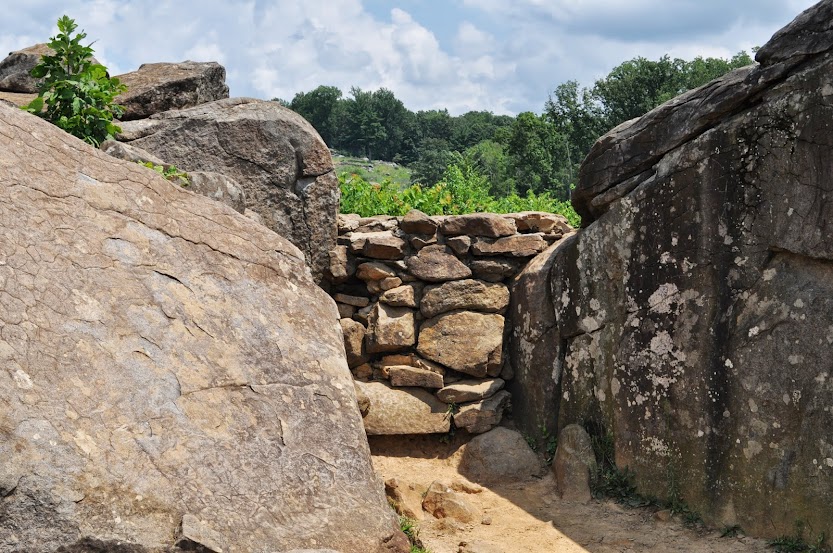
Meanwhile, down on the Union’s left flank, things weren’t going quite so well at first, even though they occupied the high ground. Longstreet’s Corps attacked, with General Hood leading an assault over the rough ground of Devil’s Den and what became known as the Slaughter Pen at the foot of Little Round Top. Fierce fighting continued as McLaws engaged Union troops in the Wheatfield and Peach Orchard throughout the day, when Sickles broke position on the high ground and brought his brigades too far forward. Despite heavy losses, the Confederates pressed their advantage, setting the stage for an assault on Little Round Top.
Devil’s Den
The Slaughter Pen
A Confederate sharpshooter’s nest, site of a famous, though staged, photograph by Alexander Gardner.
The original Gardner photograph, “Home of a Rebel Sharpshooter” (Image from Wikipedia Commons)
Here’s where the Union fishhook came into play. Meade had all interior lines of movement, and was able to move 20,000 men from other positions to reinforce the flanks at Culp’s Hil and Little Round Top. That doesn’t mean the fighting wasn’t desperate, and we’re all familiar with the famous bayonet charge performed by the 20th Maine, lead by Colonel Chamberlain. (It’s honestly one of my favorite scenes in Ron Maxwell’s “Gettysburg”.)
The charge of the 20th Maine was only a small part of the battle, and fighting would continue to rage on Culp’s Hill well into the evening. But it’s a great example of tenacity and the sort of courage displayed by many, many officers and enlisted men on both sides of the battle.
That night the Confederate cavalry under J.E.B. Stuart finally showed up, and Lee prepared for one last thrust at the Union army. A thrust he believed would crush the Union center, collapse their lines, and force Meade to retreat. Here’s where a lot of speculation comes in. Had Stuart’s cavalry been on site the entire time, had they reported the movements of Meade’s army prior to the battle, one could argue that the positioning, the planning, and execution of Lee’s maneuvers could have been quite different. Contemporary sources also point out that Lee wasn’t exactly well during the battle; he suffered from a heart ailment that would trouble him until his death in 1870, and it’s been said that the Confederate commander was ill and weak during the first days of the battle and this may have clouded his judgment.
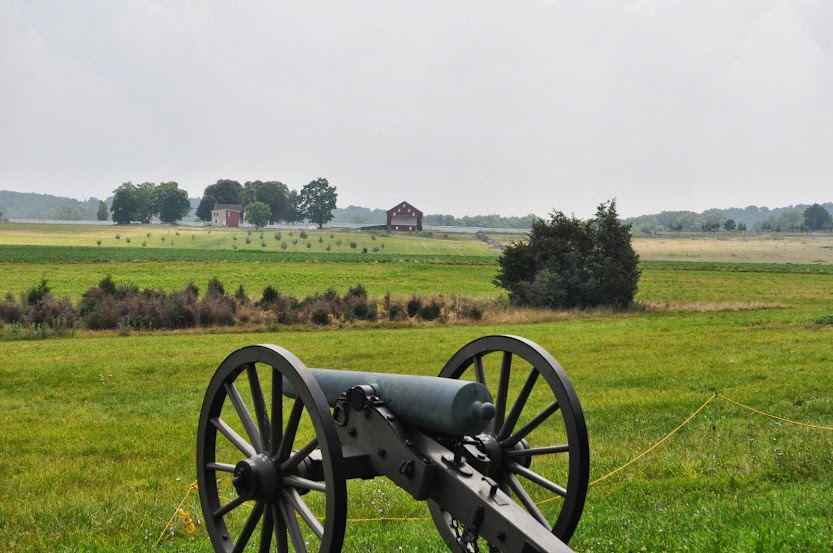
Or maybe Lee thought, as many thought, that his army just could not be defeated. So he ordered Longstreet to engage the divisions under Pickett, the only truly fresh troops they had, Trumble and Pettigrew. The plan was to commence a frontal assault on the Union positions in the center of Cemetery Ridge, where the Union line was believed to be weakest. Lee ordered an artillery bombardment that would silence the Union artillery and further weaken the center. However, the bombardment did little except to deplete the Confederates ammunition, and when the 12,500 men began their march over a 3/4 mile stretch of open ground, they were exposed to Union artillery and, when in range, rifle fire that decimated their ranks.
Confederate artillery position on Seminary Ridge
Looking out over the fields toward Cemetery Ridge. The large copse of trees a third from the right of the photograph was the point at which the Confederate charge should have converged.
Upon reaching the Emmitsburg Road, Confederate troops had to scale a five-foot high post and beam fence, further exposing them to the rifle and canister fire they were now within range of. Many men didn’t get farther than this fence.
Only Armistead’s Brigade, part of Pickett’s Division, reached the stone wall of the Angle, at the copse of trees, breaching the Union line. Armistead was killed, most men were killed or captured, and the rest of the forces retreated to Seminary Ridge
The men who survived “Pickett’s Charge” limped back to the Confederate positions on Seminary Ridge. The next day, July 4th, Lee began moving his shattered army back toward Virginia, and Vicksburg fell in the West. Meade did not pursue Lee until July 7th, and the two armies engaged in skirmishes and rear guard action for several days following the battle at Gettysburg. But by July 24th, the Army of Northern Virginia was beyond pursuit. Despite criticism from Lincoln and others in Washington, Meade remained in formal command of the Army of the Potomac until the end of the war, though Grant located his headquarters with the Army of the Potomac upon his appointment as Lieutenant General of all Union Armies in 1864.
Back at Gettysburg, civilians were left to deal with the scores of wounded and dead men around their small town. Soldiers were buried, most unidentified, and in November of 1863, the burial ground just south of Gettysburg was dedicated as a national cemetery. On November 19, Abraham Lincoln delivered a short address to recall the sacrifices of the men buried at Gettysburg, and all who had died, redefining the war and stating that “these dead shall not have died in vain—that this nation, under God, shall have a new birth of freedom—and that government of the people, by the people, for the people, shall not perish from the earth.”
The only known photograph of Lincoln giving the Gettysburg Address, November 19, 1863. Lincoln is the bareheaded man to the left-center of the photograph.
You can see more photographs from my trip to Gettysburg here.
More information about the Battle of Gettysburg can be found at:
This weekend, people across America have enjoyed parades, fireworks, barbecues, and otherwise kicked off the “official” start of the summer season (or so it’s said). Many of us, me included, get the added bonus of a long weekend.
But how many of you out there are thinking about the reason why you have a three- or four-day weekend, in which to grill, swim, run around with sparklers, and sleep in?
I personally believe it’s imperative that we honor the members of our Armed Forces. As the daughter and granddaughter of veterans, not to mention my many friends and several family members in uniform, I take the sacrifices and service of our military men and women to heart. People often confuse Veteran’s Day and Memorial Day, however. Veteran’s Day, observed on November 11th each year, is a day to honor ALL veterans, both living and dead, those currently serving and those retired, who served in times of war and times of peace.
But Memorial Day is something different, more solemn, and perhaps even more important. It is a day to honor the men and women who have died in service to our country.
In the Beginning
From 1861 to 1865, the United States was embroiled in a bitter and devastating Civil War, which resulted in the death of at least 620,000 Americans (yes, Americans – they were all Americans, both sides; sorry, but that’s my view). In fact, newer research, which includes some scientific data based on better understandings of weaponry and battle tactics, estimates that the death toll during the Civil War may have been over 700,000 between those killed outright on the field and those who died from wounds and disease. The increased numbers also take into account the fact that Confederate record keeping was a little spotty at times, and many official records were destroyed during the evacuation of Richmond on April 2, 1865.
Even before the war ended, it’s believed many women in Southern cities began decorating the graves of the Confederate dead. And once the war was over, the practice spread. It was often informal, run by local groups, and wasn’t necessarily widely recognized by communities. In 1866, many communities did start to hold formal days to decorate and honor the Civil War dead. Many towns and cities claim they held the first of such “Decoration Day” observances, but Waterloo, NY is credited with the first official observance, as it was a community wide, annual observance that was held on the same day each year.
Decoration Day Becomes a National Observance
In 1868, three years after the end of the Civil War, Congress, with backing and spearheading by the Grand Army of the Republic (the veterans’ association for members of the Union Army), declared May 30, 1868 as the first national observance of Decoration Day. The date was chosen because in all those four terrible years of war, no major battle was fought on that date. (It’s arguable that skirmishes of some magnitude happened pretty much every day during the war.) Flowers were placed on the graves of both Union and Confederate soldiers at Arlington National Cemetery.
By 1890, Decoration Day was observed in every Northern state. Many Southern states did not observe the national holiday – and I’m sure you all can understand why. However, they continued to hold their own observances to honor the Confederate dead, and this practice does continue today in many Southern states and communities. I don’t begrudge or blame them. Regardless of who won, who was right, or whatever, men on both sides fought bravely and many thousands gave their lives in service.
Decoration Day becomes Memorial Day
The United States’ entrance into World War I actually served as a unifying event between North and South, and following WWI (and the Armistice which would lead to the birth of Veteran’s Day), Decoration Day became Memorial Day, a day to honor not only the Civil War dead, but also those who died in any war. The idea of wearing a red poppy was popularized during this time as well.
For years, Memorial Day was observed on May 30th, until Congress passed the Uniform Monday Holiday Act, which moved Memorial Day to the last Monday in May. The law went into effect in 1971 and also established Memorial Day as an official Federal holiday. There has been support for many years to reestablish the observance on May 30th, in the same vein that Veteran’s Day is always observed on November 11th (unless it falls on a Saturday or Sunday), regardless of the day of the week. A bill was introduced to Congress in 1999 to this end, but nothing’s been done with it since.
Observing Memorial Day
Over the years, I think Memorial Day has lost its meaning for many people. We’re inundated with sale flyers for stores and car dealerships, the prospect of a three-day weekend, and, for many students and teachers, the start of the home stretch to summer vacation. While it’s all well and good to hold parades and fireworks, and have a backyard barbecue with friends and family, it’s not the reason we have the observance.
It’s really not hard to observe Memorial Day the way it’s meant to be. Many veterans groups, like the VFW and American Legion, spend the day decorating the graves of all military men and women with flags and flowers in tribute to their service. But it’s important to remember first and foremost those who died serving their country, from the American Revolution all the way through the wars in Iraq and Afghanistan.
At 3:00 p.m. at your local time, take a moment of silent remembrance for the men and women who have made the ultimate sacrifice. They’re the reason you get to grill that hamburger tomorrow.
Thursday, Friday, and Saturday were unabashedly full of historical geek-out for me. And almost all of it was spur of the moment and last minute discoveries.
First, I found out on Wednesday night that the preliminary draft of the Emancipation Proclamation was going to be displayed in Syracuse, for one day only, on Thursday. The 150th anniversary of the Proclamation’s issuance was September 22nd, and the document is on a tour of New York State as part of the First Step to Freedom exhibit.
Now, why was this so particularly special, besides the whole anniversary thing?
Well, this draft copy is the only surviving copy of the document, written in Abraham Lincoln’s own hand. The official final draft of the document was destroyed in the Great Chicago Fire of 1871. This preliminary draft was donated by Lincoln to the U.S. Sanitary Commission in 1864, and it was auctioned off as part of a fundraiser to raise money for the war effort. The draft was purchased by abolitionist Gerrit Smith for $1000 and then later donated to the New York State Museum.
The last time the Proclamation made “the rounds” was over 50 years ago. This was a prime opportunity. On a Thursday night. So the hubs and I ate a lighting fast dinner and hied ourselves southward to downtown Syracuse.
And stood in line for about 3 hours in what could possibly be the worst organized historical event ever. It was so anti-climatic, and by the time it was my turn to see the document, I felt guilty spending more than a few seconds taking pictures of the four pages. Which is a shame, because it could have been so cool. I mean, page 3, they think, has Lincoln’s fingerprint on it!
See the fingerprint? Right under the glued-in clipping.
But it was the chance of a lifetime, so at the end of the day I was glad I went.
Then on Friday, I discovered the music video for the song “Some Nights” by Fun.
Watch it. It freaking features the Civil War! Brings a whole new meaning to the lyrics.
And lastly, it was Civil War weekend at Fort Ontario, and Saturday was a beautiful day to catch a reenactment.
And I managed to capture the instant one of the cannons was fired.
I even got a chance to chat it up with some of the reenactors. One (the guy with the long hair sitting on the ground by the cannon) tried to recruit me.







 J. Lynn Rowan