Gettysburg

Gettysburg National Military Park has been enjoying a huge influx of visitors this week, as it’s the 150th anniversary of the battle. Called many things – the “high water mark of the Confederacy”, the turning point of the Civil War, the bloodiest battle ever fought on American soil – it’s worth taking the time to know the history of this important site and the events that made it famous.

It would be beyond amazing to visit Gettysburg this week, due to the numbers of reenactors who are there, portraying military units and civilians. But I saw a photograph yesterday of the crowds at Devil’s Den, participants in a walking battlefield tour, and frankly, it wouldn’t be worth it. I’m not sure you’d even be able to learn anything with the thousands of people milling about as they are. I like visiting battlefields in their off seasons, when it’s not so crowded. It helps me retain the feeling of time and place. As such, the hubs and the in-laws and I visited Gettysburg last summer, at the end of July. So I guess you could say I marked the 149th anniversary of the battle.

(Sit tight, folks, this is gonna be a long one.)

The Battle of Gettysburg

Nobody planned to fight at Gettysburg in July 1863. But General Lee lost one of his most brilliant generals, Thomas “Stonewall” Jackson, after the Battle of Chancellorsville in May, and he wanted to take the fight out of war-ravaged Virginia. If the Confederate army could threaten major Union cities like Baltimore, Harrisburg, and the capital of Washington, it could bring a swifter end to the war – and Southern victory.

Historians have speculated on this; had Lee’s second invasion of the North been successful, the war could have ended that summer. Things hadn’t been going well for the Union armies, at least in the Eastern Theater. By the end of June 1863, the Army of the Potomac was on their sixth commander in two years. Yes, Grant and Sherman were tearing it up in the West, scrabbling to gain control of the Mississippi River. In fact, by the time Lee marched the Army of Northern Virginia into Pennsylvania, Grant had already been engaged in a six-week siege of Vicksburg, Mississippi – a siege that was destined to end with the Confederates’ surrender on July 4th, giving the Union control of the Mississippi and effectively cutting the Confederacy in half for the remainder of the war.

But in the East, General Meade was the latest in a long line of generals, from McDowell to McClellan to Pope (to McClellan again) to Burnside to Hooker, who had to face off against Lee and a Confederate army so used to victory, their commander thought them almost unbeatable.

At the end of June, the Army of Northern Virginia marched through Maryland and into Pennsylvania, and the Army of the Potomac pursued them. Lee had no idea where the Union army was, however, since his cavalry, the “eyes and ears” of the army, was no where to be found. Lee’s army was, initially, split, with General Ewell’s forces coming so close to the city of Harrisburg that he “could hear the church bells” ringing in the steeples. But he would have to turn his divisions around and march back toward the little town of Gettysburg, because that’s where the armies converged.

The first day of fighting, July 1st, was not of the large-scale caliber that would ensue in the next two days. North of the town, the Confederates used an unfinished railroad cut to advance upon the town – legend has it they’d heard there were shoes in Gettysburg, hence the detour – and two brigades of Hill’s Third Corps ran smack into Buford’s cavalry on McPherson’s Ridge, starting the battle.

Railroad Cut north of Gettysburg

The railroad cut is finished now, of course.

Reinforcements from both armies began to stream into the area, and the battle intensified. General Reynolds was killed, and the Union troops were pushed through the town itself before taking up positions on the high ground south of town on Cemetery Ridge. Lee gave Ewell discretionary orders to attack “if practicable”, but Ewell, who didn’t have the same sort of fire in his belly as Jackson had, did not attempt to take the high ground. It’s arguable what would’ve happened if he had done so. The Union army had yet to get all of their forces into place, and had Ewell pressed his advantage, it’s possible the battle would have ended that night.

But this was not to be, and by morning on July 2nd, Meade’s forces had their defensive positions in a huge fishhook that extended from Little Round Top, along Cemetery Ridge, and curved around to Culp’s Hill. Over the course of the next day, the fighting would be fierce and deadly, with no significant ground gained by the Confederates by night fall.

Lee ordered attacks on both flanks of the Union fishhook. On Culp’s Hill, Ewell attempted to dislodge the Union troops from their positions, but with little effect. The fighting was brutal, hand to hand at times, and wounded from both sides crawled to Spangler’s Spring to get water for themselves and others.

Spangler's Spring

The spring is now filled. The plaque on the left says “One country and one flag. The strife of brothers is over.”

Meanwhile, down on the Union’s left flank, things weren’t going quite so well at first, even though they occupied the high ground. Longstreet’s Corps attacked, with General Hood leading an assault over the rough ground of Devil’s Den and what became known as the Slaughter Pen at the foot of Little Round Top. Fierce fighting continued as McLaws engaged Union troops in the Wheatfield and Peach Orchard throughout the day, when Sickles broke position on the high ground and brought his brigades too far forward. Despite heavy losses, the Confederates pressed their advantage, setting the stage for an assault on Little Round Top.

Devil's Den

Devil’s Den

The Slaughter Pen

The Slaughter Pen

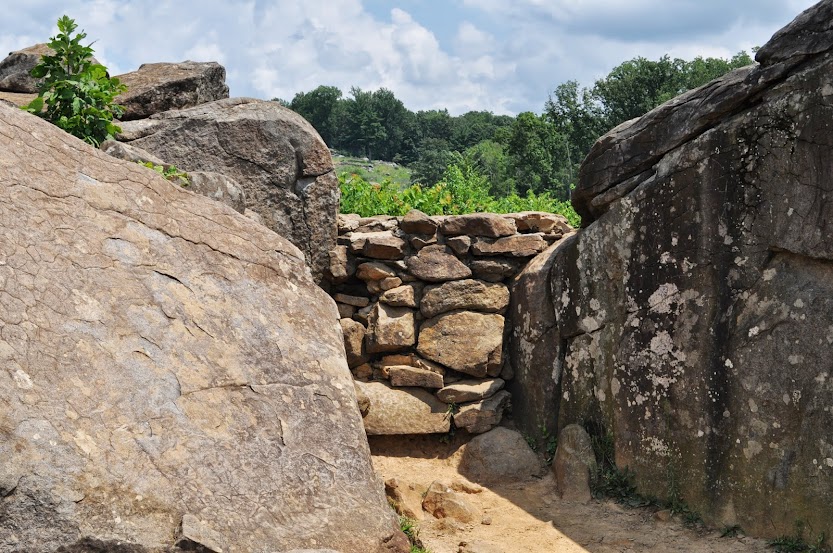
Confederate Sharpshooter's Nest

A Confederate sharpshooter’s nest, site of a famous, though staged, photograph by Alexander Gardner.

Alexander Gardner

The original Gardner photograph, “Home of a Rebel Sharpshooter” (Image from Wikipedia Commons)

Here’s where the Union fishhook came into play. Meade had all interior lines of movement, and was able to move 20,000 men from other positions to reinforce the flanks at Culp’s Hil and Little Round Top. That doesn’t mean the fighting wasn’t desperate, and we’re all familiar with the famous bayonet charge performed by the 20th Maine, lead by Colonel Chamberlain. (It’s honestly one of my favorite scenes in Ron Maxwell’s “Gettysburg”.)

The charge of the 20th Maine was only a small part of the battle, and fighting would continue to rage on Culp’s Hill well into the evening. But it’s a great example of tenacity and the sort of courage displayed by many, many officers and enlisted men on both sides of the battle.

That night the Confederate cavalry under J.E.B. Stuart finally showed up, and Lee prepared for one last thrust at the Union army. A thrust he believed would crush the Union center, collapse their lines, and force Meade to retreat. Here’s where a lot of speculation comes in. Had Stuart’s cavalry been on site the entire time, had they reported the movements of Meade’s army prior to the battle, one could argue that the positioning, the planning, and execution of Lee’s maneuvers could have been quite different. Contemporary sources also point out that Lee wasn’t exactly well during the battle; he suffered from a heart ailment that would trouble him until his death in 1870, and it’s been said that the Confederate commander was ill and weak during the first days of the battle and this may have clouded his judgment.

Or maybe Lee thought, as many thought, that his army just could not be defeated. So he ordered Longstreet to engage the divisions under Pickett, the only truly fresh troops they had, Trumble and Pettigrew. The plan was to commence a frontal assault on the Union positions in the center of Cemetery Ridge, where the Union line was believed to be weakest. Lee ordered an artillery bombardment that would silence the Union artillery and further weaken the center. However, the bombardment did little except to deplete the Confederates ammunition, and when the 12,500 men began their march over a 3/4 mile stretch of open ground, they were exposed to Union artillery and, when in range, rifle fire that decimated their ranks.
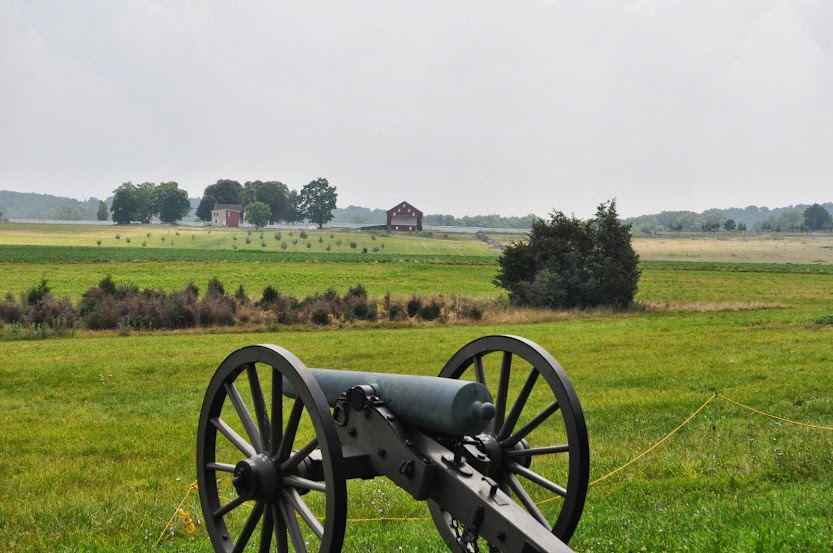
Confederate cannon on Seminary Ridge

Confederate artillery position on Seminary Ridge

Looking out at Cemetery Ridge

Looking out over the fields toward Cemetery Ridge. The large copse of trees a third from the right of the photograph was the point at which the Confederate charge should have converged.

Post & Beam fence on the Emmitsburg Road

Upon reaching the Emmitsburg Road, Confederate troops had to scale a five-foot high post and beam fence, further exposing them to the rifle and canister fire they were now within range of. Many men didn’t get farther than this fence.

High Watermark of the Confederacy - the Angle at Cemetery Ridge

Only Armistead’s Brigade, part of Pickett’s Division, reached the stone wall of the Angle, at the copse of trees, breaching the Union line. Armistead was killed, most men were killed or captured, and the rest of the forces retreated to Seminary Ridge

The men who survived “Pickett’s Charge” limped back to the Confederate positions on Seminary Ridge. The next day, July 4th, Lee began moving his shattered army back toward Virginia, and Vicksburg fell in the West. Meade did not pursue Lee until July 7th, and the two armies engaged in skirmishes and rear guard action for several days following the battle at Gettysburg. But by July 24th, the Army of Northern Virginia was beyond pursuit. Despite criticism from Lincoln and others in Washington, Meade remained in formal command of the Army of the Potomac until the end of the war, though Grant located his headquarters with the Army of the Potomac upon his appointment as Lieutenant General of all Union Armies in 1864.

Back at Gettysburg, civilians were left to deal with the scores of wounded and dead men around their small town. Soldiers were buried, most unidentified, and in November of 1863, the burial ground just south of Gettysburg was dedicated as a national cemetery. On November 19, Abraham Lincoln delivered a short address to recall the sacrifices of the men buried at Gettysburg, and all who had died, redefining the war and stating that “these dead shall not have died in vain—that this nation, under God, shall have a new birth of freedom—and that government of the people, by the people, for the people, shall not perish from the earth.”

Gettysburg Address

The only known photograph of Lincoln giving the Gettysburg Address, November 19, 1863. Lincoln is the bareheaded man to the left-center of the photograph.

You can see more photographs from my trip to Gettysburg here.

More information about the Battle of Gettysburg can be found at:

Geeking Out in 1812

In some circles (such as this one), there’s a lot of periodic hype about the Civil War’s sesquicentennial, which we’re about halfway through at the moment. But this weekend, I had a chance to immerse myself in the War of 1812, America’s “forgotten” war, which celebrates its bicentennial starting this year.

I admit that I don’t know a whole lot about the War of 1812. *gasp* I have a working knowledge: It was between the British and Americans, the majority of the action was naval in nature and really focused on the Great Lakes area due to the proximity to Canada, which at the time was a British possession. It lasted from 1812 to 1815, but on the world stage it was a bit of a blip, since most of Europe was busy, you know, trying not to be taken over by Napoleon Bonaparte.  Here in America it was a pretty big deal, as American sailors had been getting press-ganged into service aboard British naval vessels for years, among other issues. And then there was the whole burning down of Washington and the White House while Dolley Madison fled with a portrait of George Washington and some other important people and papers.

Around my neck of the woods, since I have a Great Lake in my own backyard, the War of 1812 was a rather big deal. A battle in 1814 marked the third time Fort Ontario was attacked and destroyed (once by the French, once by the British, once by the Americans). I’m looking forward to learning a lot more about this “forgotten” war in the next couple years. But in the meantime – GEEKERY!!

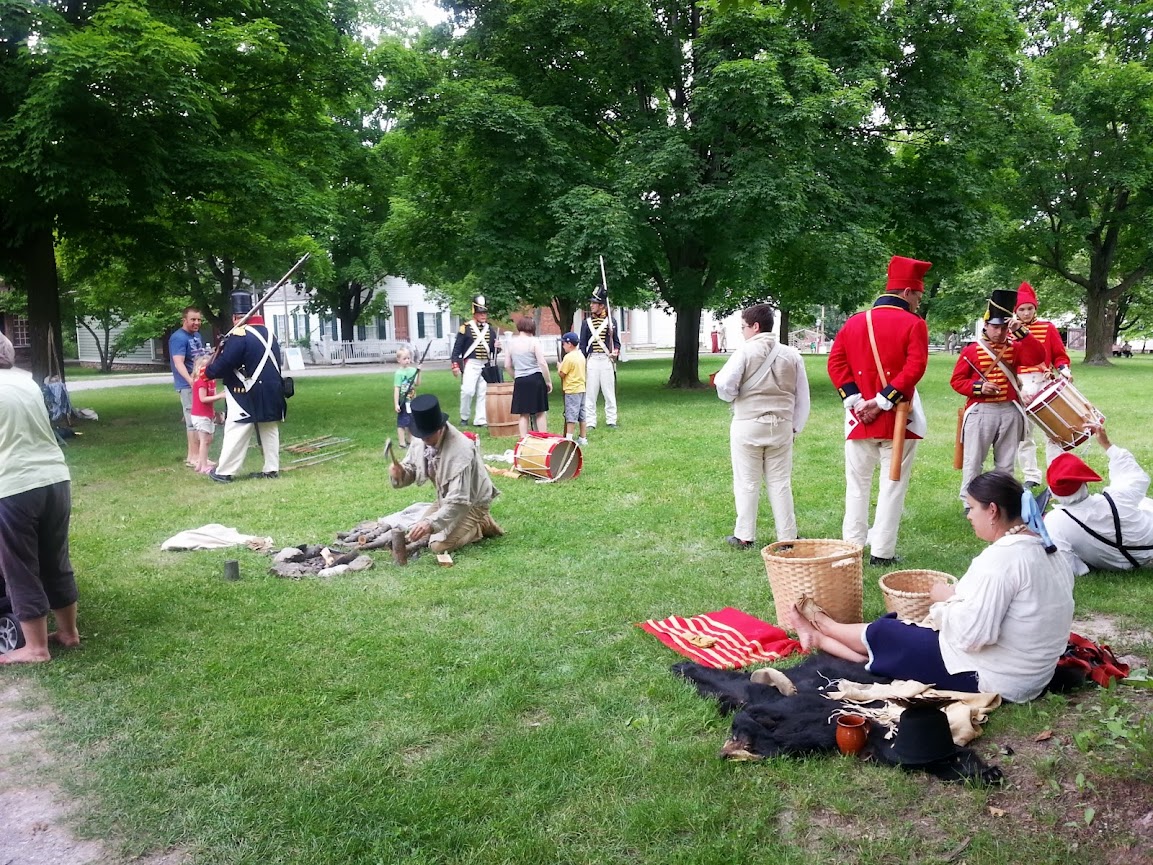
War of 1812 Reenactment

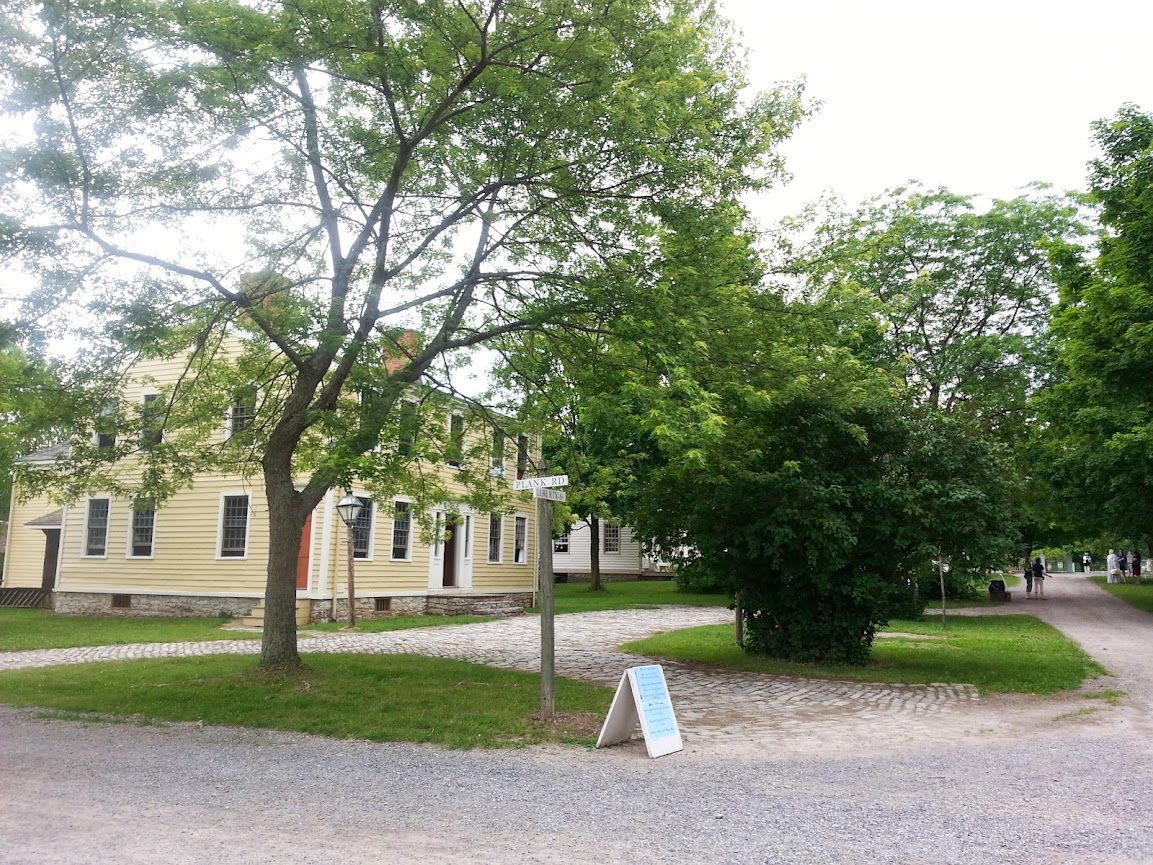
The Genesee Country Village Museum holds an annual War of 1812 reenactment, alongside a Jane Austen Weekend, in which the beautiful historic village transforms to display aspects of civilian life during the War of 1812 and the Regency Era (which we Americans would call the Federal Era, incidentally). The village itself is amazing, if you ever have a chance to visit. All the buildings are either reconstructions based on historical evidence, repurposed buildings that were originally something else, or actual historical structures that were moved to the village from all over New York State. It’s pretty amazing, and I’m planning/hoping to go back in a few weeks for their annual Civil War weekend, which boasts one of the largest reenactments in the Northeast.

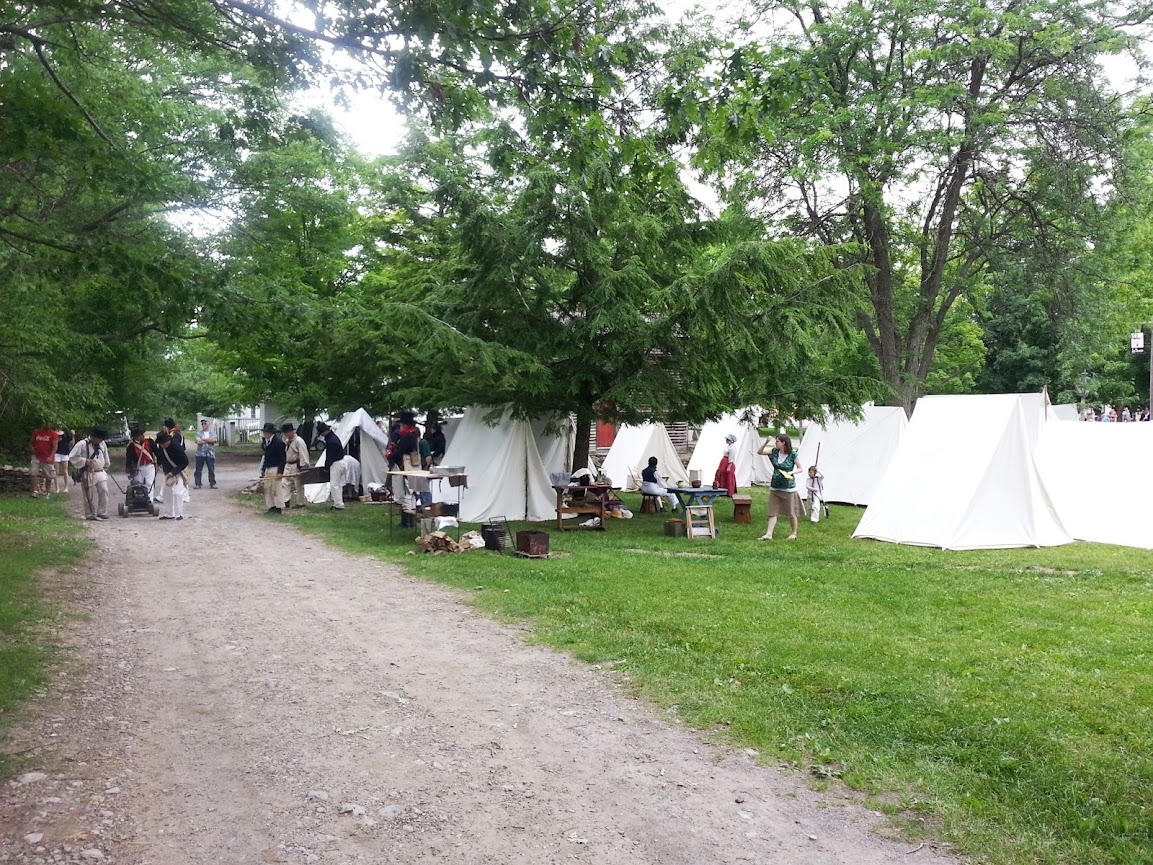
Anyway, the reenactors, who had come from all over the country, depicted life in 1812 through military encampments, demonstrations, and just generally “populating” the village to give you a feel for the time period.

Genesee Country Village Museum

Genesee Country Village Museum

War of 1812 Encampment

They even held small arms demonstrations with flintlocks, and, of course, artillery demonstrations.

My visit, however, had a totally ulterior motive. You see, I’ve been friends with Katie Jacobs for about twelve years. We “met” when I was in college and she was in high school, through an online writing group that may or may not have had to do with a particular anime show both of us enjoyed. *ahem* Anyway, since she lives in Michigan and I live in New York, we had never actually been in the same room together.

Until this weekend.

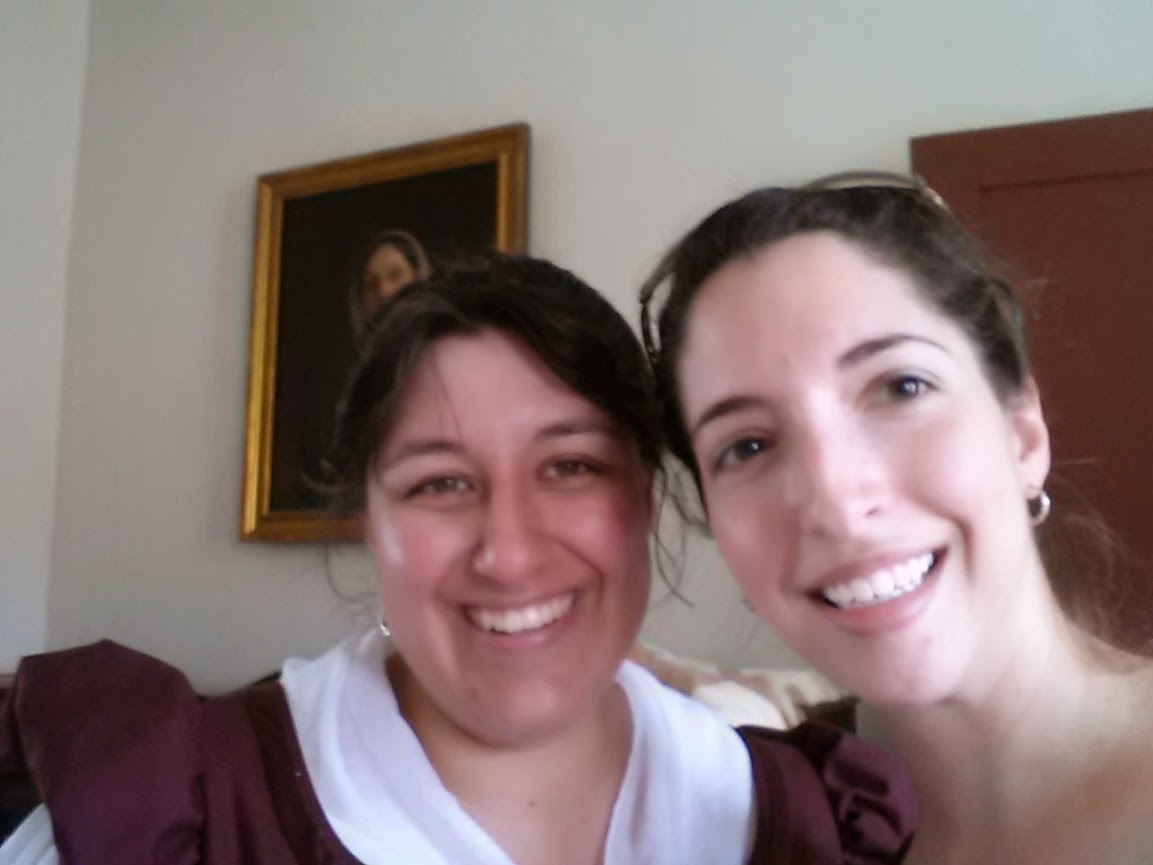
12 years of friendship. First time in a room together. Ever.

(Sorry for the super blurry picture. Sometimes self portrait shots are hard!)

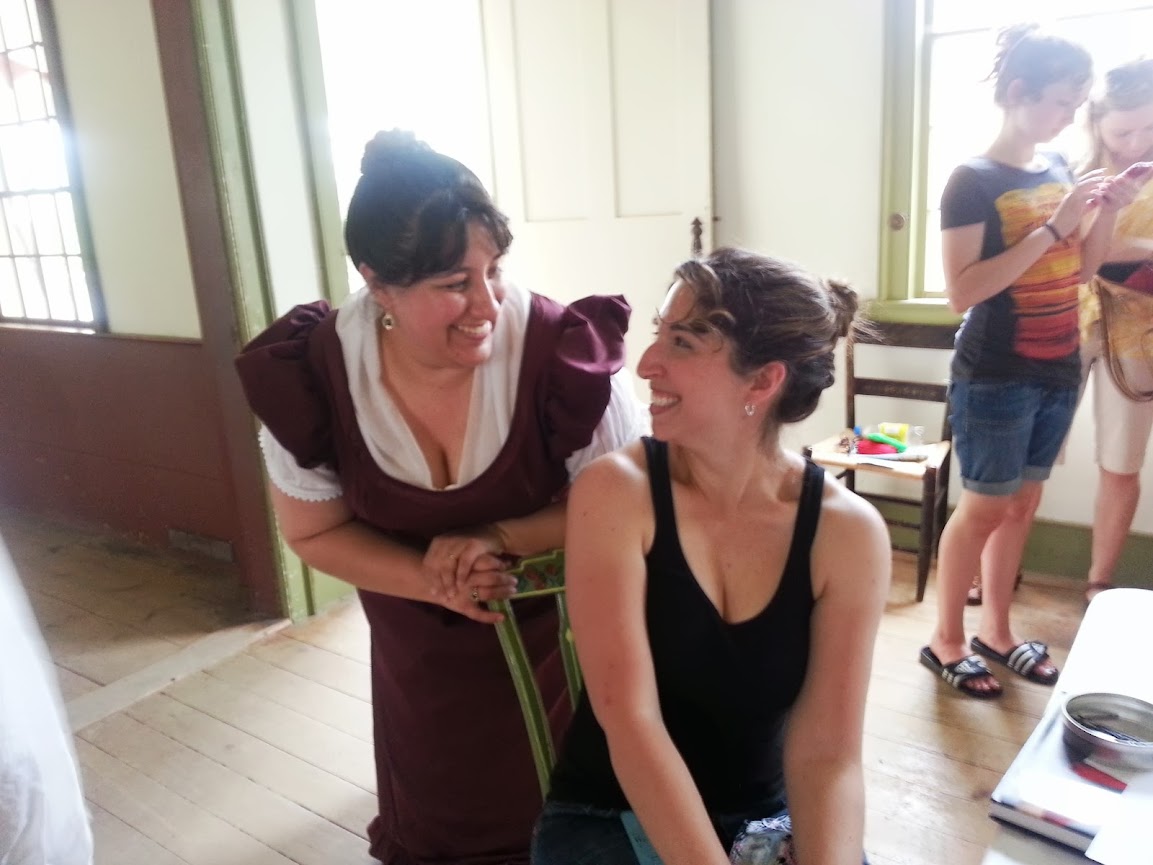
As you can see, Katie was at the Jane Austen Weekend being her amazing reenacting self. She and the group of ladies she was with were doing Regency hair demonstrations. Did I already say amazing? And I was so pleased and lucky to have Katie style my hair!

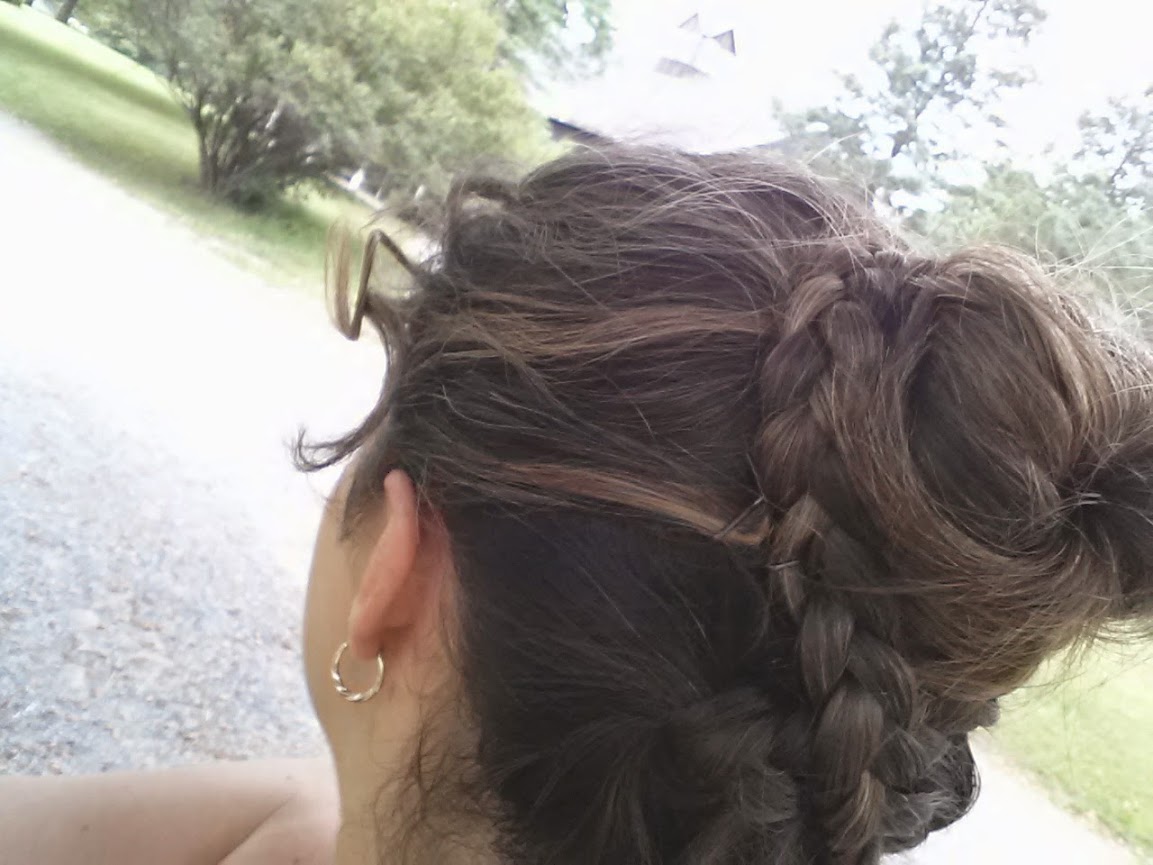
Basically all she did was pull the top half of my hair into a bun, then made two braids in the bottom half, which she then wrapped around the bun. She finished it off by adding some papillote curls to the front.

Regency Hair Style

Regency Hair Style

Now, the idea of getting into some low-level reenacting has been percolating for a while. But now I’m stoked at the idea. Except for the fact that sewing is, like, the one thing I don’t know how to do at all.

The Meaning Behind Memorial Day

This weekend, people across America have enjoyed parades, fireworks, barbecues, and otherwise kicked off the “official” start of the summer season (or so it’s said). Many of us, me included, get the added bonus of a long weekend.

But how many of you out there are thinking about the reason why you have a three- or four-day weekend, in which to grill, swim, run around with sparklers, and sleep in?

I personally believe it’s imperative that we honor the members of our Armed Forces. As the daughter and granddaughter of veterans, not to mention my many friends and several family members in uniform, I take the sacrifices and service of our military men and women to heart. People often confuse Veteran’s Day and Memorial Day, however. Veteran’s Day, observed on November 11th each year, is a day to honor ALL veterans, both living and dead, those currently serving and those retired, who served in times of war and times of peace.

But Memorial Day is something different, more solemn, and perhaps even more important. It is a day to honor the men and women who have died in service to our country.

In the Beginning

From 1861 to 1865, the United States was embroiled in a bitter and devastating Civil War, which resulted in the death of at least 620,000 Americans (yes, Americans – they were all Americans, both sides; sorry, but that’s my view). In fact, newer research, which includes some scientific data based on better understandings of weaponry and battle tactics, estimates that the death toll during the Civil War may have been over 700,000 between those killed outright on the field and those who died from wounds and disease. The increased numbers also take into account the fact that Confederate record keeping was a little spotty at times, and many official records were destroyed during the evacuation of Richmond on April 2, 1865.

Union Soldiers at Fredericksburg, 1862

Even before the war ended, it’s believed many women in Southern cities began decorating the graves of the Confederate dead. And once the war was over, the practice spread. It was often informal, run by local groups, and wasn’t necessarily widely recognized by communities.  In 1866, many communities did start to hold formal days to decorate and honor the Civil War dead. Many towns and cities claim they held the first of such “Decoration Day” observances, but Waterloo, NY is credited with the first official observance, as it was a community wide, annual observance that was held on the same day each year.

Decoration Day Becomes a National Observance

In 1868, three years after the end of the Civil War, Congress, with backing and spearheading by the Grand Army of the Republic (the veterans’ association for members of the Union Army), declared May 30, 1868 as the first national observance of Decoration Day. The date was chosen because in all those four terrible years of war, no major battle was fought on that date. (It’s arguable that skirmishes of some magnitude happened pretty much every day during the war.) Flowers were placed on the graves of both Union and Confederate soldiers at Arlington National Cemetery.

By 1890, Decoration Day was observed in every Northern state. Many Southern states did not observe the national holiday – and I’m sure you all can understand why. However, they continued to hold their own observances to honor the Confederate dead, and this practice does continue today in many Southern states and communities. I don’t begrudge or blame them. Regardless of who won, who was right, or whatever, men on both sides fought bravely and many thousands gave their lives in service.

Decoration Day in Philadelphia, PA

Decoration Day becomes Memorial Day

The United States’ entrance into World War I actually served as a unifying event between North and South, and following WWI (and the Armistice which would lead to the birth of Veteran’s Day), Decoration Day became Memorial Day, a day to honor not only the Civil War dead, but also those who died in any war. The idea of wearing a red poppy was popularized during this time as well.

Unknown soldier from WWI laid to rest at Arlington National Cemetery

For years, Memorial Day was observed on May 30th, until Congress passed the Uniform Monday Holiday Act, which moved Memorial Day to the last Monday in May. The law went into effect in 1971 and also established Memorial Day as an official Federal holiday.  There has been support for many years to reestablish the observance on May 30th, in the same vein that Veteran’s Day is always observed on November 11th (unless it falls on a Saturday or Sunday), regardless of the day of the week. A bill was introduced to Congress in 1999 to this end, but nothing’s been done with it since.

Observing Memorial Day

Over the years, I think Memorial Day has lost its meaning for many people. We’re inundated with sale flyers for stores and car dealerships, the prospect of a three-day weekend, and, for many students and teachers, the start of the home stretch to summer vacation. While it’s all well and good to hold parades and fireworks, and have a backyard barbecue with friends and family, it’s not the reason we have the observance.

Arlington National Cemetery

It’s really not hard to observe Memorial Day the way it’s meant to be. Many veterans groups, like the VFW and American Legion, spend the day decorating the graves of all military men and women with flags and flowers in tribute to their service. But it’s important to remember first and foremost those who died serving their country, from the American Revolution all the way through the wars in Iraq and Afghanistan.

At 3:00 p.m. at your local time, take a moment of silent remembrance for the men and women who have made the ultimate sacrifice. They’re the reason you get to grill that hamburger tomorrow.

Military funeral honors at Arlington National Cemetery

Sources:

“Memorial Day History” http://www.usmemorialday.org/backgrnd.html

“Memorial Day” http://www.history.com/topics/memorial-day-history

“A Brief History of Memorial Day” http://www.time.com/time/nation/article/0,8599,1900454,00.html

Photographs and Images:

Library of Congress Prints & Photographs Online Catalog: http://www.loc.gov/pictures/

Arlington National Cemetery Photo Gallery: http://www.arlingtoncemetery.mil/Gallery/

Wikipedia Commons: http://commons.wikimedia.org/

Crawling out from under my rock…

It’s been almost a month since I last posted anything, and while there are tons of great ideas fluttering around in my head, I haven’t had the time or wherewithal to focus on any one thing lately.  This week’s news of the bombing of the Boston Marathon just put the cap on productivity for the week.

I’ve had a definite lack of overall motivation for about three and a half weeks now.  I was feeling pretty down in the dumps during the last week of March, plus was swamped with report cards, but then had an awesome vacation to Arizona and Vegas with the hubs.  Pictures and tidbits are forth coming, as soon as I finish sorting through the 1000+ pictures we took (we had too much fun with our SLR camera). Then came parent conferences, and this week I had my formal observation.  I think it went well, at least.

And last weekend, I went to my very first ever writer’s retreat!

It was hosted by one of the members of CNYRW, and it was beyond amazing and fun.  Besides writing over 6k words on the CLR, I enjoyed several delicious meals, a murder mystery dinner game, a couple goal setting/reporting sessions, and tons of belly-busting laughter.  My beautiful room, the “Daffodil Hill” room, was in the part of the house that was built in 1809.

HISTORY!!!!

And you will have to excuse me for bragging a little.  When my wonderful hostess gave us a tour of the house, she also shared with me the gun that she and her husband found in the rafters of the attic when they bought the house.  I was able to find the company stamp (William Moore & Co., which seems to have been in business from 1854-1872-ish). It was a double-barrel muzzle loading percussion shotgun, very rusted.  I tried to find a stamp that might point to a date of manufacture or a location, which would help with further searching.  However, since there was no action to open the breech, and a spot where a ramrod would have been stored, I stand by my conclusion that it was a muzzle loader and likely was manufactured around the time of the Civil War or shortly beforehand.  I suspect this solely on the (slightly over researched) knowledge that breech-loading technology first started being perfected in the years just before the Civil War, though it was mostly seen in sporting rifles, not mass produced until midway through the war. By the end of the Civil War and into the Wild West era, so often portrayed in movies, the breech-loading shotgun and rifle were commonplace and preferred.

So, anyway. Yeah. It was awesome. I got to geek out a little with the Civil War era weaponry knowledge I’ve garnered in my pursuit of historical accuracy.

Plus, you know, the writing.

I’m looking forward to attending another retreat with the wonderful CNYRW authors.  Heck, I’d love to go to any writer’s retreat again!

Never Too Early to Cultivate History Geeks

While I always identify myself as a primary grade teacher, many people who know me well are often saying stuff like, “You should be teaching high school history,” because I love history so much.  I’m actually certified to teach through 9th grade in social studies, which means if I ever did move to the 7th-9th grade level, I would get to teach history all the time.

But you know what? I do get to teach history all time, despite the fact that my students are 7 and 8 years old.

Now, I know what you’re probably thinking. What kind of history could possibly be taught at the 2nd grade level?  Well, on the most basic level, you would be correct in assuming that there is very little to no history (American, world, or otherwise) in the NYS second grade social studies curriculum.  I mean, the general curriculum standards look at things like community and basic map skills, and being able to identify, say, Abraham Lincoln and Martin Luther King, Jr.

You’d be surprised how many kids think MLK was a president.  Which is awesome, but often requires some lengthy explanations.

A couple years ago, my school started using a program called Studies Weekly, which is like those good old Weekly Readers you and I used as kids (which is still in existence by the way), except nothing but social studies.  The program covers everything from school responsibilities to the Constitution, to historical figures like Frederick Douglass, to how money and markets work.  You try explaining to a 2nd grader that when you use a credit card to buy stuff at Walmart, you still have to pay somebody something at some point.

Anyway, this program is, in my book, officially awesome.  Mostly because it has given me a launch point to hold dozens of in depth discussions about various topics in history.  The little magazines cover the most basic aspects of history, geography, and economics, but I don’t stop there.

Want to know why?  Because, my God, the QUESTIONS these kids ask!

They ask fantastic questions.  They ask me for books about the people, places, and historical events we learn about.  They want to see pictures – I’ve shown them everything from a video of a Civil War artillery demonstration to different photography collections on the Library of Congress website.

Want to know what’s even better? They remember and make connections between what we’ve talked about at different points in the year.  For example, because of the yearly calendar, we learn about MLK before we learn about Abraham Lincoln.  And we study them about a month apart.  (Well, this year was a little different – we did some Lincoln learning in September when the draft of the Emancipation Proclamation was in Syracuse.)  One of my students made a very astute observation. “Abraham Lincoln and Martin Luther King were kinda the same because they both thought there were laws that were unfair and they tried to change them.”

Very simple, yes, and perhaps not a particularly accurate comparison.  But remember, this came from a 7 year old.

So I must now proudly admit that, over the past three years, I have manged to turn three classes of students into little budding history geeks.  There are some topics that I have to sort of simplify – I get asked every year when we talk about Abraham Lincoln, “Why did the Civil War start?”  Then that leads into showing some maps and discussing slavery, which in turn leads to lots of little horrified gasps at the idea that people were once treated like property.  Echoes and echoes of, “But that’s not fair!” ring through all those discussions.  And there’s visual relief on their faces when they discover that slavery was made illegal, even though it took a hundred more years for all people to start getting treated equally in this country.

But even though it’s sometimes necessary to “tidy up” very complex historical issues, the fact that the kids are so interested and ask about stuff in history proves that they can and should be taught about history. I’ve never believed in dumbing down instruction in case a student doesn’t understand a word or two.  When I read a book about MLK that talks about segregation, I just pause and explain what the word means.  Fortunately, many fantastic books, and other materials, have become available in recent years that offer instruction on topics in history while still being kid friendly.  It piques their curiosity.

This week, I just wrapped up my President Biography project with my class.  Each student had to choose one president (except George Washington and Abraham Lincoln, since we learn so much about them in class) to study and write a very brief biography about.  They were so excited to choose their presidents, and during reading station time and free time, they looked through the books and information about other presidents by choice.

I can’t wait to do the women’s history project at the end of this month.

Now, I do realize that most 2nd graders are naturally curious, which is why they get just as excited about finishing all 100 addition or subtraction problems on their weekly timed test as they do when I break out the magnets or read about George Washington.  And I also realize that in just a few short years, that curiosity will be stunted by the general apathy that accompanies the onset of puberty.

But maybe, just maybe, someday I’ll stumble across a former student at a Civil War reenactment who will tell me, “Mrs. Rowan, you made me love history.”